• العربية
  • پښتو
  • فارسی
Brand
  • Afghanistan
  • Sport
  • Analysis
  • Markets
  • Afghanistan
  • Sport
  • Analysis
  • Markets
  • Theme
  • Language
    • العربية
    • پښتو
    • فارسی
  • Afghanistan
  • Sport
  • Analysis
  • Markets
All rights reserved for Volant Media UK Limited
volant media logo

India Sends Another Shipment Of Medicines & Medical Supplies To Afghanistan

Aug 20, 2026, 14:13 GMT+1

India has donated medicines and medical supplies to a hospital in Kabul. Foreign Ministry spokesman Randhir Jaiswal said New Delhi remained committed to supporting the Afghan people in health and medical care.

Jaiswal wrote on X on Thursday, 20 August, that another consignment of medicines and disposable medical supplies had arrived at Kabul airport. He said India would continue supporting Afghanistan’s healthcare system.

The Indian official did not specify the quantity of medicines and medical equipment provided. The Taliban has also not yet officially commented on the assistance.

Images shared by Jaiswal showed a large shipment of medicines and medical supplies at Kabul airport.

Following rising tensions with Islamabad and the closure of border crossings with Pakistan, the Taliban has sought greater cooperation from India in the health sector.

India has donated dozens of tons of medicines and medical equipment to Afghanistan over the past year. In late June, it also provided about five tons of medicines. Before that, India sent more than 75 tons of medicines and medical supplies in December and February.

An Afghanistan International report in February found that medicine prices in Kabul had risen by as much as 40 per cent, three months after the Taliban ordered an end to pharmaceutical trade with Pakistan.

According to the report, formal medicine trade with Pakistan had stopped, and many medicines were entering Afghanistan through smuggling routes.

Most Viewed

Opposition Groups Feature Prominently In Taliban Leaders’ Speeches
1

Opposition Groups Feature Prominently In Taliban Leaders’ Speeches

2

Engagement With Taliban Has Gained Momentum, Says India

3

Taliban Must Listen To Afghan People, Says Interior Minister Haqqani

4

42 Children Wounded In Kabul Education Centre Blast, Says UN

5

Four Detained By Taliban After Explosion At Kabul School

•
•
•

More Stories

Taliban Turns To Iran & Central Asia As Western Engagement Declines

Aug 20, 2026, 10:59 GMT+1
100%

A new study shows that as the Taliban has increasingly turned towards regional powers, engagement with Western countries has fallen to its lowest level since the group returned to power.

According to the report, Iran, China, Türkiye, Qatar, Uzbekistan and India have become the Taliban’s main diplomatic partners.

A new study by the Washington Institute for Near East Policy found that over the past five years, from 15 August 2021 to 15 August 2026, the Taliban had a total of 3,651 diplomatic interactions with 103 countries and international organisations.

Although most countries still refuse to recognise the Taliban government, the group has expanded ties with neighbouring states and several regional powers during this period.

Western Engagement Declines

According to the study, the share of Taliban diplomatic interactions involving Western countries has fallen sharply over the past five years.

In the first year after the Taliban returned to power, Western countries accounted for 16 per cent of the group’s diplomatic interactions. By the fifth year, that figure had fallen to five per cent.

The study said the decline in Western engagement was linked to the Taliban’s sweeping restrictions on women and girls, including the ban on education. The situation has also limited Western governments’ access to key Taliban decision-makers.

At the same time, issues such as human rights, women’s education and counterterrorism have become less prominent in diplomatic meetings with the Taliban, while economic and trade issues have gained greater importance.

Aaron Zelin, a researcher at the Washington Institute, said Russia and China still discuss the threat posed by Islamic State Khorasan Province with the Taliban, but issues such as al-Qaeda, Tehreek-e-Taliban Pakistan and cross-border terrorism, which have been priorities for Western countries, appear less frequently on the Taliban’s diplomatic agenda.

According to Zelin, the Taliban has learned that it can gain significant international concessions without backing down on major security and human rights issues.

However, he said Washington still retains tools that could be used to pressure the Taliban on sensitive issues, including Afghanistan’s seat at the United Nations, US Treasury exemptions and funding for projects in Central Asia.

Russia’s Recognition of the Taliban

Russia’s formal recognition of the Taliban government in July 2025 was the group’s most significant diplomatic achievement over the past five years.

Russia was the first, and remains the only, country to formally recognise the Taliban government.

Following recognition, Taliban representatives attended the Moscow Format meeting at ministerial level, and in May 2026 the two sides signed an agreement on military and technical cooperation.

Iran Leads as Engagement by China and Qatar Falls

According to the study, Iran had the highest number of diplomatic interactions with the Taliban over the five-year period, with 494 contacts.

China followed with 432 interactions, Turkey with 394, Qatar with 347 and Uzbekistan with 316.

However, engagement by China and Qatar has declined in recent years.

China’s interactions with the Taliban fell from 135 in the third year to 46 in the fifth year, while Qatar’s contacts dropped from 160 in the first year to 41 in the fifth.

India, by contrast, has gradually increased its contacts with the Taliban despite having been a strong opponent of the group before the collapse of the former regime.

New Delhi’s interactions with the Taliban rose from just two in the early years to 39 in the fifth year.

Relations between the Taliban and Pakistan have followed a different pattern from those with other neighbouring countries.

Interactions between the two sides rose to 86 in the fourth year but fell to 33 in the fifth year amid worsening security disputes and border clashes.

The Washington Institute report said Pakistan had shifted over the five-year period from being one of the Taliban’s main supporters to becoming a regional rival.

According to the report’s author, what stands out across these relationships is that access to the new Afghanistan depends less on ideological affinity than on geographic proximity and material interests.

Countries that engage most frequently with the Taliban, he said, are also those least inclined to raise issues that remain important to the United States and its allies.

Focus Shifts to Maintaining Existing Relationships

The study shows that the pace at which the Taliban established new relationships with other countries has slowed.

In its first and second years in power, the Taliban established contacts with 35 and 37 new countries respectively. In the fifth year, only three new countries were added to its list of diplomatic interactions.

The trend suggests that the Taliban is now more focused on maintaining and consolidating existing relationships than on expanding its diplomatic network.

Over the same period, the share of consular issues in Taliban diplomatic engagement rose from two per cent to 14 per cent.

Trade and investment issues now appear in more than 40 per cent of the group’s diplomatic reports.

Comparison With Syria

In one part of the study, the Washington Institute compared Taliban diplomacy with that of Syria’s new government.

According to the data, Syria’s new government recorded more than 4,000 diplomatic interactions in 20 months.

The pace of Syria’s diplomatic engagement was more than three times that of the Taliban administration.

Syria has also rapidly expanded relations with major Western countries, particularly the United States, something the Taliban has failed to achieve.

Taliban Still Needs the West

Despite expanding relations with regional countries, the Taliban still needs Western assistance and cooperation to address Afghanistan’s economic problems.

More than half of Afghanistan’s population of 45 million depends on humanitarian assistance, millions of migrants have returned to the country, and billions of dollars in Afghan foreign reserves remain blocked in the United States.

Taliban Foreign Minister Amir Khan Muttaqi recently told The New York Times that the United States could reopen its embassy in Kabul and invest in major economic projects in Afghanistan.

However, the Taliban has so far shown no sign of being willing to change its policies on women’s rights, girls’ education or relations with extremist groups in exchange for improved ties with the West.

The United States and other countries, meanwhile, continue to call on the Taliban to cut ties with terrorist groups and respect human rights.

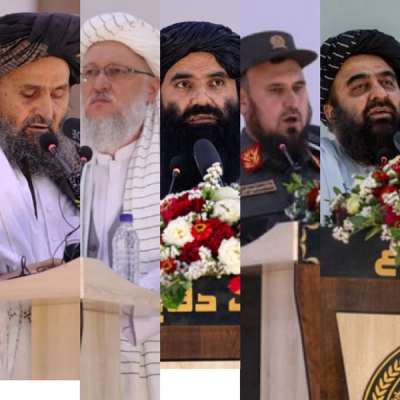
Opposition Groups Feature Prominently In Taliban Leaders’ Speeches

Aug 19, 2026, 12:55 GMT+1
100%

Top Taliban leaders, including the group’s economic and administrative deputy prime ministers, interior and foreign ministers and army chief, devoted a significant part of their Independence Day speeches to opponents, urging them to end fighting & activities against the Taliban.

Mullah Baradar, the Taliban deputy prime minister for economic affairs, described opponents as destructive and malicious elements and called on them to stand with the Taliban, leave Afghanistan’s suffering people in peace and refrain from fuelling “civil war”.

Abdul Salam Hanafi, the Taliban deputy prime minister for administrative affairs, warned against what he called ethnic, linguistic and regional prejudice, saying such divisions could harm the unity of “Muslims and mujahideen”.

Hanafi claimed that “the world’s intelligence agencies” were fuelling ethnic and linguistic divisions in Afghanistan through cultural and economic activities.

Taliban Interior Minister Sirajuddin Haqqani said Afghanistan was the “common home” of all and that everyone should consider themselves part of the Taliban system.

Haqqani urged Taliban opponents living abroad to stop fighting, saying their actions were harming both themselves and the Afghan people.

Fasihuddin Fitrat, the Taliban army chief, said opponents could not challenge the group and urged them to return to the country instead of what he described as “plotting” against the Taliban.

He said the Taliban’s “arms are open” to opponents and that they could return to Afghanistan and enjoy protection but warned that anyone disrupting order and security would face a “decisive, serious and crushing” response.

Taliban Foreign Minister Amir Khan Muttaqi called on opponents to refrain from actions that, in his view, could pave the way for instability in the country.

Muttaqi said Taliban opponents had failed, despite five years of preparation, to take control of any part of Afghanistan.

He also warned regional countries not to allow their territory to be used for pursuing war in Afghanistan.

The remarks come despite the Taliban previously rejecting negotiations and political participation with opposition groups.

The repeated emphasis by senior Taliban leaders on their opponents reflects concern over the rise in armed activity in the country.

Armed groups opposing the Taliban have increased their attacks against the group in recent months to an unprecedented level.

The Afghanistan Freedom Front, National Resistance Front, Sepahiyan-e Mihan Front, United Front of Afghanistan and Republican Front are among the groups that have recently targeted Taliban forces in different provinces.

The Sepahiyan-e Mihan Front recently seized Yaftal district in Badakhshan from Taliban control for the first time and disarmed Taliban fighters there.

The Afghanistan Freedom Front has also recently engaged Taliban forces in frontline fighting in Zebak district of Badakhshan, where intense clashes have taken place.

The United Front of Afghanistan has meanwhile organised and carried out attacks against the Taliban in several provinces.

Engagement With Taliban Has Gained Momentum, Says India

Aug 19, 2026, 11:46 GMT+1
100%

India’s Foreign Ministry defended the presence of an official at a Taliban takeover anniversary event at the Afghan embassy in Delhi, saying India’s engagement with the Taliban has gained momentum over the past year.

Randhir Jaiswal, spokesman for the ministry, said India’s engagement with the Taliban remained focused on humanitarian assistance and development cooperation with Afghanistan.

Speaking at a press briefing on Tuesday, 18 August, Jaiswal confirmed that Anand Prakash, head of the Pakistan, Afghanistan and Iran division at India’s Foreign Ministry, attended what he described as Afghanistan’s victory day event on behalf of the Indian government.

“Afghanistan organised its Victory Day here yesterday, in which our Joint Secretary, who looks after Afghanistan, as you mentioned, his presence was there from our side, on behalf of the Government of India.,” he said.

The Indian Foreign Ministry spokesperson said India had long-standing ties with the Afghan people.

Jaiswal said India had expanded its engagement with Afghanistan over the past year, including through diplomatic contacts, humanitarian aid and development assistance.

He said the level and nature of India’s engagement with Taliban-ruled Afghanistan would continue to be guided by those priorities.

He also said New Delhi upgraded its diplomatic representation in Kabul in October 2025, converting its technical mission back into an embassy. According to him, an acting head of mission has also been appointed.

He stressed that the change did not amount to an upgrade in India’s formal relations with the Taliban administration.

Asked about the situation of women in Afghanistan, Jaiswal said several women had also attended Monday’s event at the Afghan embassy in New Delhi.

Without elaborating on Taliban restrictions on women, he said India’s position on the issue had already been made clear.

Noor Ahmad Noor, the Taliban chargé d’affaires in New Delhi, called on Monday for greater political trust and expanded economic cooperation between Afghanistan and India.

India’s contacts with the Taliban have increased as relations between the Taliban and Pakistan have become more strained.

Pakistan has accused both the Taliban and India of supporting armed groups opposed to Islamabad, allegations both sides have rejected.

Taliban Must Listen To Afghan People, Says Interior Minister Haqqani

Aug 19, 2026, 10:51 GMT+1
100%

Taliban Interior Minister Sirajuddin Haqqani called on the group’s opponents to stop fighting, saying they should not ruin their own lives or those of the Afghan people.

Speaking in Kabul on Wednesday, 19 August, at a ceremony marking the 107th anniversary of Afghanistan’s independence, Haqqani said: “My advice to those who oppose us and live abroad is: do not ruin your own lives and the lives of the people.”

He added that harming people at the instigation of “foreigners” was compatible with neither “Afghan identity nor Islam”.

The Taliban interior minister described Afghanistan as the common home of all ethnic groups, languages and regions, saying the country’s strength lay not in division but in unity.

Haqqani said Afghanistan should be a country in which Pashtuns, Tajiks, Hazaras, Uzbeks, Turkmens, Baloch, Pashai, Nuristanis and other ethnic groups regard themselves as partners and primary stakeholders in the country.

He said no one should impose their personal views and preferences on the public and that the will of citizens and their legitimate demands should be respected.

Haqqani said people should not be “insulted or humiliated” for demanding their legitimate rights.

He again described Afghanistan as the common home of its different ethnic and linguistic communities and said the country’s strength was rooted in “unity”.

Haqqani added that just as the Afghan people had supported the Taliban in its war against what it called “occupiers”, the group should now listen to the public’s views on rebuilding the country.

Haqqani also said security could not be achieved solely through weapons and security forces.

“Social justice, public satisfaction, the rule of law, sound governance and trust between the people and the government” were, he said, among the fundamental pillars of lasting security.

He said security was the most basic need of the Afghan people and that conditions should be created in which every citizen felt safe at home, in their village and in the marketplace.

Haqqani stressed that the Taliban’s responsibility was not merely to recall the “heroism of the past”, but to preserve Afghanistan’s independence by meeting people’s daily needs, improving their lives and rebuilding the country.

He said independence was only “complete” when a country had security, strengthened its economy, expanded unity and was able to meet the needs of its people.

He also called for relations with other countries based on “mutual respect”.

Haqqani said 19 August, Afghanistan’s Independence Day, was accepted by all Afghans, while what he called the country’s second liberation and independence following the defeat of the Soviet Union was also accepted to some extent.

However, he said 15 August, the anniversary of the Taliban’s takeover of Afghanistan, was not accepted by the public.

The Taliban interior minister said that perhaps in the future, when the current Taliban leadership was no longer alive, people might also commemorate and accept 15 August.

Haqqani claimed that the consolidation of Taliban rule had brought national unity to Afghanistan.

He added that independence was not simply about commemorating a historical event, but would only be complete when a generation was educated with sufficient medical, technical and vocational knowledge and skills to meet Afghanistan’s needs and free the country from dependence on others.

India Deepens Taliban Engagement With Official Presence At ‘Victory’ Event

Aug 18, 2026, 10:18 GMT+1
100%

In the latest sign of closer ties between India and the Taliban, Anand Prakash, a senior Indian Foreign Ministry official, attended an event in New Delhi marking the fifth anniversary of the Taliban’s return to power.

The Taliban held events marking the fifth anniversary of its return to power at the Afghan embassies in Islamabad and New Delhi, two days after the anniversary.

Prakash, who heads the Pakistan, Afghanistan and Iran division at India’s Ministry of External Affairs, represented India at the event held at the Afghan embassy in New Delhi.

However, no senior Pakistani government official attended the Taliban’s event in Islamabad.

The Taliban held a lavish ceremony on Monday at the five-star Serena Hotel in Islamabad.

Noor Ahmad Noor, the Taliban’s chargé d’affaires in India, said in a speech that growing political trust, expanding economic cooperation and continued engagement between Afghanistan and India were in the interests of both countries and could contribute to regional stability, greater connectivity and shared prosperity.

He also thanked India’s Ministry of External Affairs and Foreign Minister S Jaishankar for what he described as their support for Afghanistan’s international rights, and called for greater Indian support for Afghanistan.

Senior Taliban officials have made several visits to India in recent months as the group’s relations with Pakistan have deteriorated. The most significant were a visit by Taliban Foreign Minister Amir Khan Muttaqi to New Delhi in October 2025 and a visit by Taliban Industry and Commerce Minister Nooruddin Azizi to India in November 2025.

India has not formally recognised the Taliban administration. However, last year it allowed Taliban diplomats to take control of the Afghan embassy in New Delhi while also upgrading the level of its diplomatic representation in Kabul.

Despite India’s lack of formal recognition of the Taliban administration, Afghanistan’s national flag continues to fly at the country’s embassy in New Delhi. The Taliban, however, is permitted to hold events and meetings at the embassy under its own flag.

The strengthening of relations between the Taliban and India comes as ties between the Taliban and Pakistan have become increasingly strained in recent months.

Referring to visits by senior Taliban officials to India in recent years, Noor said relations between the two countries had made significant progress and developed on the basis of “mutual respect, political engagement and shared interests”.