• العربية
  • پښتو
  • فارسی
Brand
  • Afghanistan
  • Sport
  • Analysis
  • Markets
  • Afghanistan
  • Sport
  • Analysis
  • Markets
  • Theme
  • Language
    • العربية
    • پښتو
    • فارسی
  • Afghanistan
  • Sport
  • Analysis
  • Markets
All rights reserved for Volant Media UK Limited
volant media logo

Engagement With Taliban Has Gained Momentum, Says India

Aug 19, 2026, 11:46 GMT+1

India’s Foreign Ministry defended the presence of an official at a Taliban takeover anniversary event at the Afghan embassy in Delhi, saying India’s engagement with the Taliban has gained momentum over the past year.

Randhir Jaiswal, spokesman for the ministry, said India’s engagement with the Taliban remained focused on humanitarian assistance and development cooperation with Afghanistan.

Speaking at a press briefing on Tuesday, 18 August, Jaiswal confirmed that Anand Prakash, head of the Pakistan, Afghanistan and Iran division at India’s Foreign Ministry, attended what he described as Afghanistan’s victory day event on behalf of the Indian government.

“Afghanistan organised its Victory Day here yesterday, in which our Joint Secretary, who looks after Afghanistan, as you mentioned, his presence was there from our side, on behalf of the Government of India.,” he said.

The Indian Foreign Ministry spokesperson said India had long-standing ties with the Afghan people.

Jaiswal said India had expanded its engagement with Afghanistan over the past year, including through diplomatic contacts, humanitarian aid and development assistance.

He said the level and nature of India’s engagement with Taliban-ruled Afghanistan would continue to be guided by those priorities.

He also said New Delhi upgraded its diplomatic representation in Kabul in October 2025, converting its technical mission back into an embassy. According to him, an acting head of mission has also been appointed.

He stressed that the change did not amount to an upgrade in India’s formal relations with the Taliban administration.

Asked about the situation of women in Afghanistan, Jaiswal said several women had also attended Monday’s event at the Afghan embassy in New Delhi.

Without elaborating on Taliban restrictions on women, he said India’s position on the issue had already been made clear.

Noor Ahmad Noor, the Taliban chargé d’affaires in New Delhi, called on Monday for greater political trust and expanded economic cooperation between Afghanistan and India.

India’s contacts with the Taliban have increased as relations between the Taliban and Pakistan have become more strained.

Pakistan has accused both the Taliban and India of supporting armed groups opposed to Islamabad, allegations both sides have rejected.

Most Viewed

Anti-Taliban Demonstrations Held In 28 Cities Around The World
1

Anti-Taliban Demonstrations Held In 28 Cities Around The World

2

India Deepens Taliban Engagement With Official Presence At ‘Victory’ Event

3

ISIS May Have Carried Out Attack On Kabul School, Says Taliban Spokesperson

4

Explosion Near School In Western Kabul Wounds Several People

5

Taliban Envoy In New Delhi Refers To Pakistan’s Lahore As Indian City

•
•
•

More Stories

Taliban Must Listen To Afghan People, Says Interior Minister Haqqani

Aug 19, 2026, 10:51 GMT+1
100%

Taliban Interior Minister Sirajuddin Haqqani called on the group’s opponents to stop fighting, saying they should not ruin their own lives or those of the Afghan people.

Speaking in Kabul on Wednesday, 19 August, at a ceremony marking the 107th anniversary of Afghanistan’s independence, Haqqani said: “My advice to those who oppose us and live abroad is: do not ruin your own lives and the lives of the people.”

He added that harming people at the instigation of “foreigners” was compatible with neither “Afghan identity nor Islam”.

The Taliban interior minister described Afghanistan as the common home of all ethnic groups, languages and regions, saying the country’s strength lay not in division but in unity.

Haqqani said Afghanistan should be a country in which Pashtuns, Tajiks, Hazaras, Uzbeks, Turkmens, Baloch, Pashai, Nuristanis and other ethnic groups regard themselves as partners and primary stakeholders in the country.

He said no one should impose their personal views and preferences on the public and that the will of citizens and their legitimate demands should be respected.

Haqqani said people should not be “insulted or humiliated” for demanding their legitimate rights.

He again described Afghanistan as the common home of its different ethnic and linguistic communities and said the country’s strength was rooted in “unity”.

Haqqani added that just as the Afghan people had supported the Taliban in its war against what it called “occupiers”, the group should now listen to the public’s views on rebuilding the country.

Haqqani also said security could not be achieved solely through weapons and security forces.

“Social justice, public satisfaction, the rule of law, sound governance and trust between the people and the government” were, he said, among the fundamental pillars of lasting security.

He said security was the most basic need of the Afghan people and that conditions should be created in which every citizen felt safe at home, in their village and in the marketplace.

Haqqani stressed that the Taliban’s responsibility was not merely to recall the “heroism of the past”, but to preserve Afghanistan’s independence by meeting people’s daily needs, improving their lives and rebuilding the country.

He said independence was only “complete” when a country had security, strengthened its economy, expanded unity and was able to meet the needs of its people.

He also called for relations with other countries based on “mutual respect”.

Haqqani said 19 August, Afghanistan’s Independence Day, was accepted by all Afghans, while what he called the country’s second liberation and independence following the defeat of the Soviet Union was also accepted to some extent.

However, he said 15 August, the anniversary of the Taliban’s takeover of Afghanistan, was not accepted by the public.

The Taliban interior minister said that perhaps in the future, when the current Taliban leadership was no longer alive, people might also commemorate and accept 15 August.

Haqqani claimed that the consolidation of Taliban rule had brought national unity to Afghanistan.

He added that independence was not simply about commemorating a historical event, but would only be complete when a generation was educated with sufficient medical, technical and vocational knowledge and skills to meet Afghanistan’s needs and free the country from dependence on others.

India Deepens Taliban Engagement With Official Presence At ‘Victory’ Event

Aug 18, 2026, 10:18 GMT+1
100%

In the latest sign of closer ties between India and the Taliban, Anand Prakash, a senior Indian Foreign Ministry official, attended an event in New Delhi marking the fifth anniversary of the Taliban’s return to power.

The Taliban held events marking the fifth anniversary of its return to power at the Afghan embassies in Islamabad and New Delhi, two days after the anniversary.

Prakash, who heads the Pakistan, Afghanistan and Iran division at India’s Ministry of External Affairs, represented India at the event held at the Afghan embassy in New Delhi.

However, no senior Pakistani government official attended the Taliban’s event in Islamabad.

The Taliban held a lavish ceremony on Monday at the five-star Serena Hotel in Islamabad.

Noor Ahmad Noor, the Taliban’s chargé d’affaires in India, said in a speech that growing political trust, expanding economic cooperation and continued engagement between Afghanistan and India were in the interests of both countries and could contribute to regional stability, greater connectivity and shared prosperity.

He also thanked India’s Ministry of External Affairs and Foreign Minister S Jaishankar for what he described as their support for Afghanistan’s international rights, and called for greater Indian support for Afghanistan.

Senior Taliban officials have made several visits to India in recent months as the group’s relations with Pakistan have deteriorated. The most significant were a visit by Taliban Foreign Minister Amir Khan Muttaqi to New Delhi in October 2025 and a visit by Taliban Industry and Commerce Minister Nooruddin Azizi to India in November 2025.

India has not formally recognised the Taliban administration. However, last year it allowed Taliban diplomats to take control of the Afghan embassy in New Delhi while also upgrading the level of its diplomatic representation in Kabul.

Despite India’s lack of formal recognition of the Taliban administration, Afghanistan’s national flag continues to fly at the country’s embassy in New Delhi. The Taliban, however, is permitted to hold events and meetings at the embassy under its own flag.

The strengthening of relations between the Taliban and India comes as ties between the Taliban and Pakistan have become increasingly strained in recent months.

Referring to visits by senior Taliban officials to India in recent years, Noor said relations between the two countries had made significant progress and developed on the basis of “mutual respect, political engagement and shared interests”.

Anti-Taliban Demonstrations Held In 28 Cities Around The World

Aug 17, 2026, 16:09 GMT+1
100%

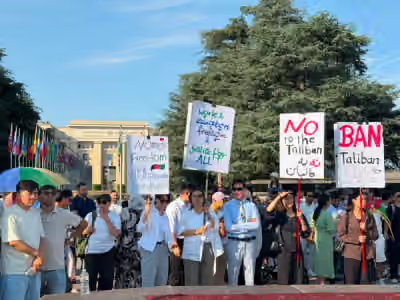
Protests marking the fifth anniversary of the Taliban’s return to power have spread to 28 cities worldwide, with many demonstrators urging governments not to normalise ties with the group and to recognise gender apartheid in Afghanistan.

According to information compiled by Afghanistan International, protests marking the fifth anniversary of the Taliban’s return to power were held in Bonn, Geneva, Amsterdam, Munich, Stuttgart, Hamburg, Islamabad, Berlin, Kiel, Frankfurt, Helsinki, Zurich, Oslo, Cologne, Vienna, The Hague, Stockholm, Madrid, Barcelona, Bilbao, Toronto, New Westminster, Reston, Düsseldorf, Tehran, Paris, London and Washington.

In some cities, Afghans took to the streets and chanted slogans against the Taliban.

Elsewhere, organisers held meetings, advocacy events, protest tents and hunger strikes.

Many of the events focused about Afghan women and girls and opposition to the normalisation of relations between governments and the Taliban.

Bonn

In Bonn, Germany, the Campaign Against Gender Apartheid in Afghanistan held a rally outside the United Nations office and issued a resolution at the end of the event.

The resolution called on the United Nations and the international community to recognise and criminalise gender apartheid, halt efforts to legitimise the Taliban and ensure that the voices of Afghan women, victims, protesters, civil society and democratic forces are included in international decision-making.

Several Afghans also held a protest outside the UN office in Bonn to mark the fifth anniversary of the Taliban’s return to power.

Geneva

In Geneva, Switzerland, a gathering in support of Afghan women and girls was held outside the United Nations office.

Organisers said the event aimed to keep Afghan women’s voices alive, draw international attention to the human rights situation and emphasise the rights, freedom, equality and human dignity of women and girls.

Berlin

In Berlin, protest activities continued for several days.

Organisers set up a protest tent and held a voluntary hunger strike, with the programme concluding on 15 August with a final gathering near the Brandenburg Gate.

They said the events were intended to support human dignity, freedom, equality and human rights in Afghanistan.

Munich

In Munich, Afghan activists, academics, human rights defenders, political figures, artists and members of the public gathered at Bellevue di Monaco.

Women joining live from Afghanistan and Pakistan also spoke about the restrictions, concerns and experiences they face.

Human rights, the situation of women and girls, education, the economy, migration, asylum and the role of Germany and the European Union towards Afghanistan were among the subjects discussed.

The final resolution said that education, employment, freedom and human dignity were fundamental rights.

Organisers also called for any political engagement with the Taliban to take account of the human rights situation and not lead to the normalisation of violations against the Afghan people.

Kiel

In Kiel, Germany, a protest titled Voice of the Unseen was followed by a cultural programme.

The Schleswig-Holstein Refugee Council also called for an end to deportations to Afghanistan and greater protection for Afghans at risk.

Amsterdam

In Amsterdam, several organisations held demonstrations marking the fifth anniversary of the Taliban’s entry into Kabul.

Protesters called on the Netherlands and the European Union not to legitimise the Taliban and to prioritise the rights of Afghan women.

Images of the gathering in Dam Square were also published.

Madrid, Barcelona and Bilbao

Events were held in Madrid, Barcelona and Bilbao in Spain.

In Madrid, Afghan women, refugees and feminist groups gathered in Puerta del Sol.

Protesters also called on the international community to take action in support of Afghan women’s rights.

Madrid, Barcelona and Bilbao were among the cities participating in a coordinated international campaign for 15 August, centred on opposition to gender apartheid and the legitimisation of the Taliban.

Toronto

In Toronto, protesters gathered at Queen’s Park.

Participants stressed women’s right to education and employment and called on Canada not to recognise the Taliban.

The Afghan community in Toronto also issued a resolution calling for an end to gender apartheid, opposition to normalising relations with the Taliban, guarantees for the rights of women and girls, freedom of expression and the media, support for refugees and independent investigations into human rights violations.

Islamabad

In Islamabad, several Afghan women’s protest movements, organisations and human rights groups held a joint event.

Participants chanted slogans against the Taliban, emphasised women’s right to education, employment and freedom, and said women’s civil struggle for freedom, justice and equality would continue.

Hamburg

In Hamburg, Afghan migrants and civil society activists held a demonstration marking the fifth anniversary of the Taliban’s return to power and condemned the group’s rule and violations of the rights and freedoms of Afghans.

Participants also criticised the German government’s policy towards the Taliban and the deportation of refugees to Afghanistan, calling for stronger support for women’s rights, civil liberties and the Afghan population.

A conference titled Five Years of Taliban Rule: The Current Situation, Germany’s Afghanistan Policy and the Resistance of Hamburg’s Afghan Community was also held at Hamburg City Hall.

Representatives of the Afghan community, civil society activists and guests discussed Afghanistan’s political, social and humanitarian situation after five years of Taliban rule, Germany’s Afghanistan policy and the issue of deportations.

Engagement with the Taliban and the consequences of such policies were also among the main topics.

Frankfurt

In Frankfurt, Afghan citizens and activists marked the fifth anniversary of the Taliban’s return to power by describing 15 August as a black day in Afghanistan’s history.

Protesters chanted slogans including “No to the Taliban”, “Do not recognise the Taliban” and “Education, work, freedom”.

Participants called on the international community to support the fundamental rights of Afghans, particularly women’s and girls’ rights to education and employment, civil liberties and human rights.

They urged governments and international organisations not to recognise the Taliban without respect for the rights of the Afghan people.

Oslo

Several events related to the fifth anniversary were also held in Oslo.

At one event, protesters marched from the Afghan embassy towards the Norwegian parliament.

Organisers stressed their support for Afghan women’s struggle.

Another gathering titled “From Advocacy to Accountability” focused on justice, accountability, cooperation among human rights defenders and the future of advocacy for Afghanistan.

The event was organised by Dialogue Hub for Common Ground and the Women’s Justice Movement.

New Westminster

In New Westminster, Canada, an event titled Fresh Wound: From Remembrance to Action was held.

Expert speeches, a panel discussion, protest music and theatre were among the activities, while human rights, gender apartheid, cultural genocide and the future of civil activism were discussed.

Cologne

In Cologne, Germany, a gathering titled Five Years of Taliban Rule was held at Heumarkt square.

Organisers, including Afghanistan Is Not Safe Cologne and Bonn, Anar Academy, Amnesty International Cologne and Mosaik Köln-Mülheim, expressed solidarity with Afghan women and girls and protested the human rights situation after five years of Taliban rule.

Reston

In Reston, Virginia, an event titled Afghanistan, Five Years After the Fall was held on 15 August at the North County Governmental Center.

The event aimed to remember victims, amplify the voices of Afghan women, refugees and separated families, and discuss Afghanistan’s future.

It was scheduled from 3 pm to 6 pm.

Related events marking the fifth anniversary of the Taliban’s return to power were also held in Stuttgart, Helsinki, Zurich, Vienna, The Hague, Stockholm and Düsseldorf.

A ‘Victory Day’ for the Taliban and a ‘Black Day’ for Opponents

On 15 August 2021, as US and NATO forces were withdrawing, the Taliban entered Kabul following the collapse of the republic and returned to power in Afghanistan.

Then-president Mohammad Ashraf Ghani left the country the same day, and the Taliban took control of the capital without widespread resistance.

The Taliban has since marked 15 August as “Victory Day” or “Day of Conquest”, describing it as the end of what it calls the “occupation” of Afghanistan, and holds annual ceremonies and speeches by its officials.

By contrast, many Taliban opponents, civil society activists, human rights defenders and Afghan citizens describe the date as a “black day” and organise protests in different countries.

Five years after the Taliban’s return, its government remains unrecognised by every country except Russia.

Since returning to power, the Taliban has imposed sweeping restrictions on the lives of Afghans, particularly affecting women and girls in education, employment and participation in public life.

Over 700 Aid Trucks Enter Afghanistan Through Pakistan, Says UN

Aug 17, 2026, 15:19 GMT+1
100%

The United Nations said on Sunday that more than 700 trucks carrying international humanitarian aid had entered Afghanistan through Pakistan.

Olga Cherevko, spokesperson for the UN Office for the Coordination of Humanitarian Affairs (OCHA) in Afghanistan, told Agence France-Presse that the shipments included food and essential humanitarian supplies.

According to the United Nations, a total of 724 trucks carrying humanitarian cargo entered Afghanistan.

The deliveries come as the land border between Afghanistan and Pakistan has remained largely closed since October last year because of tensions between the Taliban and Pakistan.

Mohamed Yahya, the United Nations resident coordinator in Pakistan, said on X that the 724 trucks had reached families most in need of assistance.

He thanked Islamabad and everyone involved in keeping what he described as a vital humanitarian corridor open.

Food Crisis Remains Critical

The aid has entered Afghanistan as the country continues to face a serious food and malnutrition crisis.

The World Food Programme warned in early August that acute child malnutrition in Afghanistan had reached critical levels this year.

According to the agency, following last year’s deadly earthquakes, several climate-related disasters this year and the return of millions of Afghans from Iran and Pakistan since 2023, nearly 14 million people out of Afghanistan’s population of 40 million are facing acute hunger.

Border Closure Disrupts Aid Routes

Tensions between the Taliban and Pakistan, which have led to the near-total closure of the countries’ land border since October 2025, have also created serious difficulties for the delivery of humanitarian aid to Afghanistan.

Carl Skau, deputy executive director of the World Food Programme, told Agence France-Presse in May that the closure of the Pakistan border had severely disrupted humanitarian logistics routes into Afghanistan.

One example was the delivery of fortified biscuits for Afghan schoolchildren.

The shipments had been due to enter Afghanistan through Pakistan, but the border closure forced aid agencies to reroute them through Iran.

However, the war in Iran also disrupted that route and caused further delays.

The fortified biscuits eventually reached Afghanistan several months later through a lengthy combination of land and sea routes, including through Jordan, Turkey and Azerbaijan.

The arrival of the latest humanitarian shipments from Pakistan comes as the continued border closure and disruption of supply routes remain major obstacles to delivering essential assistance to millions of Afghans in need.

Taliban Deputy Intelligence Chief Warns Of Internal Threats to the System

Aug 15, 2026, 12:54 GMT+1
100%

Tajmir Jawad, the Taliban’s deputy intelligence chief, has acknowledged the presence of opportunistic individuals within the Taliban administration, saying their activities are being monitored and action will be taken against them.

Jawad said strengthening the Taliban administration requires the efforts of people with ideological, intellectual and religious commitment, warning of attempts to undermine what he described as the achievements of 20 years of war.

In a message marking the fifth anniversary of the Taliban’s return to power, he said people who joined the group solely for “material benefits” could not be expected to struggle or make sacrifices to strengthen the system.

Without naming anyone, Jawad said that just as certain individuals had previously been used to undermine the “achievements of the jihad against the Soviet Union”, similar figures were now being used to damage the Taliban’s achievements of 20 years of war.

The Taliban deputy intelligence chief said, without providing details, that different aspects of these efforts were being monitored and that necessary measures were being taken to prevent those behind them from achieving their objectives.

Jawad described efforts to consolidate the Taliban administration as a continuation of the group’s 20-year “jihad”, saying those loyal to the system would defend it because of their ideological, intellectual and religious ties.

His remarks come as activity and attacks by armed opposition groups have increased in recent days and weeks ahead of the fifth anniversary of Taliban rule.

At the same time, fighting between forces loyal to Juma Khan Fateh, a dissident Taliban commander, and Taliban forces in Nusay district of Badakhshan has entered its fifth day.

Local sources say the Taliban has continued air strikes while sending reinforcements to Badakhshan and preparing for a large-scale ground operation.

Informed sources previously told Afghanistan International that the operation against Fateh’s forces was launched on the orders of Tajmir Jawad, the Taliban’s deputy intelligence chief.

The dispute between Juma Khan Fateh and the Taliban leadership began months ago over mining activities and intensified after several of his associates were detained on the orders of the Taliban governor of Badakhshan.