Will Take Back US Weapons Left In Afghanistan From Taliban, Says Trump

US President-elect Donald Trump has announced that he will withdraw the US weapons left in Afghanistan from the Taliban.

US President-elect Donald Trump has announced that he will withdraw the US weapons left in Afghanistan from the Taliban.
He sharply criticised the Biden administration for leaving US weapons in Afghanistan, saying, "They handed over our military equipment to the enemy."
In a speech at the Capitol One Arena in Washington on Sunday, January 19, Donald Trump called Joe Biden's administration officials "incompetent" and strongly criticised billions in aid to Afghanistan.
Addressing his supporters, he said, "Do you know that we used to give billions of dollars to Afghanistan every year?"
The US president-elect called the Taliban "enemies" and said that we should tell them that we will not give them money unless they return military equipment.
Donald Trump said during his election campaign that Afghanistan is one of the largest sellers of US military equipment in the world. He described the US withdrawal from Afghanistan as the most embarrassing moment in the country's history.
Trump has repeatedly stated that the value of US military equipment in Afghanistan is $85 billion.
On the third anniversary of the withdrawal of foreign forces from Afghanistan, the Taliban held a military parade with US weapons. At the same time, Donald Trump blamed the Taliban's parade with American weapons as the result of Biden's "stupid" policy.
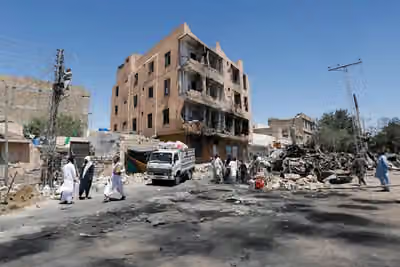
During a meeting with the Taliban, Iran's deputy interior minister Ali Akbar Pourjamshidian called for "the establishment of a direct channel of communication between Iran's intelligence, security and law enforcement agencies" and the Taliban.
Deputy Interior Minister for Security and Law Enforcement Affairs, Ali Akbar Pourjamshidian met with Abdul Malik Haqqani, deputy of the Taliban's Supreme Court, in Tehran.
Iranian media reported on Sunday that Pourjamshidian stressed during the meeting that the establishment of a direct channel between the intelligence and security agencies of the two sides can play an effective role in strengthening bilateral relations.
He added, "The two countries have always fought common enemies over the past years, and this has caused the enemies of the two Muslim nations to seek to exploit and create discord."
He stressed on the need for "vigilance on both sides to thwart these conspiracies" and mentioned the fight against terrorist groups, drug and human trafficking, expansion of judicial cooperation, extradition of criminals, immigration and border issues as important priorities in the relations between the two countries.
Iranian media reported that the Taliban delegation also called the establishment of a direct channel between the specialised departments of the two countries "the most effective solution to common issues in the fields of legal, judicial, citizens' affairs, borders, counter-terrorism and transnational organised crimes".
This is the first time that an Iranian official has publicly called for the establishment of an "intelligence channel" with the Taliban.
The Taliban has close relations with the Islamic Republic of Iran in the fields of security and intelligence. According to reports, the Islamic Republic has the most influence in the Taliban's leadership circle in Kandahar and has established close ties with some of the group's senior commanders. Iran has also played a significant role in the Taliban's victory.
‘Alternative Punishment For Afghan Refugees’
Meanwhile, the Taliban's Supreme Court announced that the group's delegation visited the children's prison in Tehran and called for addressing the problems of Afghan prisoners, especially imprisoned juveniles.
The Supreme Court said in a statement on Sunday that the administrative deputy of this institution met with the deputy of the Iranian judiciary on Saturday. In this meeting, the issue of alternatives to the death penalty for Afghan refugees sentenced to death in Iran was discussed.
Abdul Malik Haqqani called on the Iranian authorities to be lenient in dealing with Afghan refugees sentenced to death and to consider alternative methods of executing their punishment.
Iran regularly executes Afghan immigrants imprisoned in the country.
The Taliban has called for a ban on the execution of Afghan refugees in Iran, while the group itself has been accused of field trials, rape of prisoners, detention of dissidents, and widespread human rights violations.

Kioumars Heydari, Commander of the Iranian Army’s Ground Forces, has announced the completion of 50 kilometres of a border wall along Iran’s shared boundary with Afghanistan.
He stated that 100 kilometres of the project are expected to be completed and operational by the end of the year.
During a visit to the construction site on Sunday, Heydari informed IRNA: “Additionally, 30 kilometres of border obstruction in the first phase are ready for wall construction and installation.”
According to Heydari, over 80 kilometres of infrastructure necessary for various stages of this major project have already been completed in the region. He expressed confidence that the current planning would ensure 100 kilometres of the project are finalised and operational by year-end.
The commander revealed that the entire border wall construction, spanning 300 kilometres along the shared border with Afghanistan, is projected to take three years to complete.
Heydari highlighted that the project incorporates advanced border surveillance technologies and is designed to be “fully intelligent.” The border obstruction features a four-metre-high wall with a metal fence installed on top.
Khorasan Razavi province, where part of this project is being implemented, shares an approximately 532-kilometre border with Turkmenistan to the north and northeast, and a 302-kilometre border with Afghanistan to the east.

The Afghanistan Freedom Front (AFF) has claimed responsibility for an explosion in the central square of Pol-e-Khomri city, targeting a convoy of Taliban intelligence vehicles.
The attack occurred on the evening of Saturday, 18 January, according to a statement released by the group on Sunday.
The AFF stated, “As a result of this attack, four Taliban members were killed, and two others were injured.” The group also added that Mullah Ibrahim Mansoori, a Taliban intelligence commander, was among those targeted, but his fate remains unclear.
Residents of Baghlan province earlier reported the explosion to Afghanistan International, which occurred in Pol-e-Khomri city on Saturday afternoon.
The Afghanistan Freedom Front is an armed resistance group opposing the Taliban, formed after the fall of the previous Afghan government in 2021. The AFF identifies itself as a defender of freedom, justice, and the rights of the Afghan people.
The group has declared its mission to achieve an Afghanistan free from extremism and has embraced armed struggle as a means to achieve this goal.

The Taliban has announced that Iran will soon transfer 1,500 Afghan prisoners to Afghanistan. The announcement, made by the Taliban’s Supreme Court, did not provide specific details regarding the timing or conditions of the transfer.
In a statement issued on Sunday, the Taliban’s Supreme Court revealed that a delegation led by Abdul Malik Haqqani, the court’s administrative deputy, met with Kazem Gharibabadi, the Deputy Chief for International Affairs of the Iranian Judiciary, during a visit to Tehran.
The statement highlighted discussions between the two sides aimed at strengthening judicial and legal cooperation. Among the key topics was the transfer of Afghan prisoners currently held in Iranian custody.
The Taliban also claimed to have raised the issue of exploring alternatives to the death penalty for Afghan prisoners facing execution in Iran. The rights of Afghan migrants were reportedly another topic of discussion during the talks.
In the past, concerns have been raised about the treatment of Afghan prisoners handed over by Iran to the Taliban. There are fears that some of these individuals may be opponents of the Taliban and could face human rights violations upon their return.
This development comes amidst broader issues in Afghan-Iranian relations, including the treatment of Afghan migrants, the execution of Afghan prisoners in Iran, and ongoing judicial interactions between the two countries. These remain significant and contentious matters in their bilateral relationship.

Jan Egeland, Secretary General of the Norwegian Refugee Council (NRC), described the denial of girls’ education in Afghanistan as “heartbreaking” and “intolerable” during a visit to a women’s carpet-weaving centre in Herat.
Egeland noted that the girls weaving carpets at the centre have been deprived of their right to education. One child labourer shared her story, saying: “I only finished Year 5, but my dream is still to become a doctor.”
On Saturday, Egeland posted on the social media platform X that he had returned to Afghanistan, where 22 million people are in need of humanitarian aid. Amid this crisis, Pakistan has deported 800,000 Afghan refugees, and Iran is planning to expel an additional two million.
During his visit to Herat, Egeland met women who have returned to Afghanistan without their husbands and now live in poverty and despair. He also visited a women’s entrepreneurship centre in Parwan province. He shared that Parwana, an entrepreneur supported by the NRC in 2021, now employs 20 female tailors, all of whom are the primary breadwinners for their families.
Egeland criticised the slow pace of financial support for humanitarian initiatives aimed at empowering Afghan women.
The Taliban has banned girls from attending school beyond Year 6 and has closed universities to women. The regime has also imposed severe restrictions on Afghan women, including prohibiting them from working, visiting parks, travelling without a male guardian, and working with international organisations.
Several human rights groups and activists have accused the Taliban of implementing a system of “gender apartheid.”
