Amnesty International Calls On Pakistan To Immediately Release Afghan Refugees

Amnesty International issued a statement on Friday calling for the immediate release of Afghan refugees held by Pakistani police.

Amnesty International issued a statement on Friday calling for the immediate release of Afghan refugees held by Pakistani police.
Pakistani police have detained hundreds of Afghan refugees in the cities of Rawalpindi and Islamabad in recent days and deported a number of them.
Amnesty International on Friday, January 17, called on the Pakistani government to repeal its new policy of requiring additional documents, such as a No Objection Certificate (NOC), to stay in Islamabad.
The organisation said that Pakistan's new order is putting vulnerable and at-risk Afghan groups in a bad situation. "The New Year has been marked by fear and anxiety for Afghan refugees in Islamabad, as police launched night-time raids, harassing and arbitrarily detaining hundreds of Afghan refugees," the organisation said in a statement.
For the past two weeks, Pakistani police have been going from street to street and house to house in the cities of Islamabad and Rawalpindi in search of Afghan migrants, arresting undocumented migrants and, in a number of cases, even migrants with visas.
Among the detainees are women and children.
According to statistics from the Taliban embassy in Islamabad, Islamabad police arrested about 800 Afghan refugees in the first week alone.
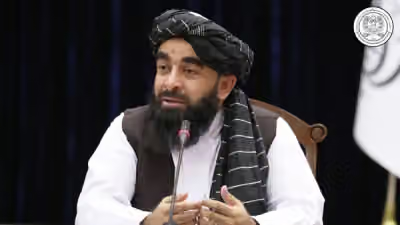

Abdul Malik Haqqani, the administrative deputy of the Taliban’s Supreme Court, left for Iran on Friday, January 17, along with a delegation.
During its two-day visit, the delegation is scheduled to meet and discuss with the Iranian Minister of Justice, the head of the Extradition Committee for Convicts, and other high-ranking officials of the Islamic Republic.
The Taliban’s Supreme Court said that the purpose of this trip is to strengthen judicial cooperation, ensure the rights of Afghan prisoners in Iran, seek an alternative way for Afghans sentenced to death in Iran, and pursue the issue of the extradition of prisoners.
According to the Human Rights Organisation Hengaw, the Islamic Republic of Iran executed at least 74 Afghan prisoners in 2024.
Earlier, a delegation from the Iranian Ministry of Justice had traveled to Kabul. Following these talks, it was agreed that Afghan prisoners would be transferred from Iran to Afghanistan to serve their sentences.

Lawrence Technological University in the United States has conducted a survey and found that more than three years after the US withdrawal from Afghanistan and the return of the Taliban to power, almost 90 percent of Afghans are facing hunger.
According to this survey, in Afghanistan under Taliban control, more than 84 percent of citizens also do not have access to health services.
Research by Lawrence Technological University researchers also showed that 85 percent of Afghans have been "threatened with violence”.
According to the university, about 800 Afghans, 94 percent of whom were men, participated in the survey and shared their views on humanitarian aid, restrictions on freedom of expression and women's rights, widespread malnutrition, and high unemployment rates.
Participants were between 18 and 29 years old.
The researchers who conducted the survey said about the current situation in Afghanistan, "The bleak situation in the country has become so severe that almost every person, regardless of their background, has been negatively affected."
According to the survey, 72 percent of participants also said that one or more of their family members were killed or displaced from the country after the Taliban returned.
The survey also showed that nearly nine out of every 10 Afghans have had their quality of life reduced due to high levels of social and psychological stress.
The survey also reported high levels of psychological stress among Afghans.
After the Taliban returned, most citizens in Afghanistan under the group's control rely on humanitarian aid, and millions more have migrated due to security threats and widespread poverty.

The Taliban’s Minister of Water and Energy claimed that in “participatory and partisan governments” in Afghanistan, the construction of water dams was prevented in order to gain the consent of a tribe or a neighbouring country.
He said that “their government is independent and now no one can prevent the construction of dams”.
Abdul Latif Mansour, the Taliban's Minister of Water and Energy, said at an investment attraction meeting in Kabul on Thursday that their political, economic and industrial policies are independent.
He added that in their government, "no one is upset about the construction of dams”.
The Taliban minister accused previous Afghan governments of refusing to build water dams out of political interests and in compliance with the wishes of neighbouring countries.
According to him, "In the past, when there were participatory governments, whenever a dam construction plan was proposed in a region, a high-ranking person would be upset and say, 'Don't build this dam because it concerns my people or tribe.' Or, he was friendly with a country and said, 'That country will be upset.'"
Mansour added that previous governments were unable to manage water resources due to wars and financial incapacity. He described the situation in Afghanistan under Taliban rule as good and appealed to investors to invest.
The Taliban's efforts to build dams have raised concerns among neighbouring countries. Recently, a spokesman for the Iranian Foreign Ministry said that since the planning of dams in Afghanistan, the issue of securing Iran's water rights from border and shared rivers has been on the Islamic Republic's agenda.
Officials of the Islamic Republic have described the construction of dams, including the Salma, Pashdan, and Bakhshabad dams, as a serious threat to agriculture in some provinces of the country, such as Khorasan and Sistan and Baluchestan.

According to Human Rights Watch's annual report, the human rights situation in Afghanistan has deteriorated drastically in 2024.
The Taliban has exacerbated the economic and humanitarian crisis by intensifying repression against women and girls, imposing severe restrictions on freedom of expression, media, and human rights.
On Thursday, January 16, Human Rights Watch released its annual report on the human rights situation in nearly 100 countries, including Afghanistan.
The international human rights organisation has announced that its monitoring of the situation in Afghanistan shows that the human rights situation in the country has deteriorated in 2024.
Human Rights Watch's annual report states that more than 23 million people in Afghanistan are in need of humanitarian assistance, while the rights of women and girls to education, employment, and freedom of movement have been severely violated. Also, the repression of political dissent, arbitrary arrests and torture continues.
The report emphasises that the Taliban has enacted new laws during this period that deprive women of many of their basic rights, including a ban on higher education, severe restrictions on freedom of movement and employment, and strict measures on public dress and behavior.

The Afghanistan Security Watch said there were at least 39 security incidents in Afghanistan in December.
It said on Thursday that 25 of the incidents had been confirmed by independent sources.
According to the Afghanistan Security Watch, the Afghanistan Freedom Front has organised 12 attacks against the Taliban, while the National Resistance Front has carried out six attacks on the Taliban during this period.
The Afghanistan Security Watch said in a statement on Thursday, January 16, that one security incident during this period was carried out by ISIS-K and six other incidents were carried out by unknown factors. The attacks took place in Kabul, Badghis, Herat, Parwan and Nangarhar provinces, the organisation said.
The Afghanistan Security Watch noted that security incidents in December were three fewer than in November. However, it acknowledged that the incidents confirmed by independent sources increased by 10 in December compared to the previous month.
In its statement, the security agency said that the Afghanistan Freedom Front has organised the most attacks on the Taliban this month. The Afghanistan Security Watch wrote that the National Resistance Front and Afghanistan Freedom Front said that they had killed 67 Taliban members and injured 64 of the group's fighters this month.
The National Resistance Front of Afghanistan and the Afghanistan Freedom Front are political-military movements opposed to the Taliban that are led from outside Afghanistan. The two fronts have previously said that no civilians were harmed in their attacks against the Taliban.