115 Migrant Families Return from Pakistan & Iran, Says Taliban
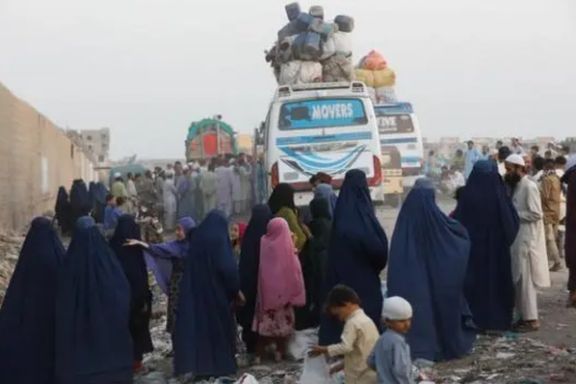
The Taliban-controlled Bakhtar News Agency has reported that, within the past 24 hours, 115 migrant families have returned to Afghanistan from Iran and Pakistan.

The Taliban-controlled Bakhtar News Agency has reported that, within the past 24 hours, 115 migrant families have returned to Afghanistan from Iran and Pakistan.
These families entered Afghanistan through the Spin Boldak, Torkham, Pul-e-Abrisham, and Islam Qala border crossings.
According to two reports published by the Bakhtar News Agency regarding their return, the families have been referred to international organisations for assistance.
Since the Taliban’s rise to power in August 2021, hundreds of thousands of Afghan citizens have sought refuge in neighbouring countries, particularly Iran and Pakistan. However, both nations detain and deport thousands of Afghan migrants back to Afghanistan each month.
The United Nations High Commissioner for Refugees (UNHCR) has reported that between 15 September 2023 and 30 November 2024, over 783,000 Afghans have returned to Afghanistan from Pakistan. Additionally, the Islamic Republic of Iran has announced plans to deport two million Afghan migrants by the end of the current year.


Inayatullah Khwarizmi, a spokesman for the Taliban's Ministry of Defence, said that the group does not consider Khyber Pakhtunkhwa to be part of Pakistan.
The ministry said in a statement on Saturday that it had attacked points on the other side of the "hypothetical Durand Line".
When asked if the statement referred to Pakistan, Defence Ministry spokesman Inayatullah Khwarizmi said, "We do not consider it to be Pakistani territory, so we cannot confirm that it was on Pakistani soil, but the attack was carried out on the other side of the hypothetical line," Reuters reported.
On Friday, the Taliban attacked targets in North Waziristan and Kurram areas of Khyber Pakhtunkhwa province in attacks from Khost and Paktika provinces.
AFP quoted a senior Pakistani border official as saying that at least one Pakistani soldier was killed and seven others were wounded in the attack.
The Taliban's Ministry of Defence announced on Saturday that it had carried out retaliatory attacks about three days after a Pakistani airstrike on Paktika Province.
The defence ministry statement did not specifically mention Pakistan, but said that the strikes had been carried out "beyond the hypothetical Durand Line". The "Durand Line" is a term commonly used by Taliban officials to refer to the border between Afghanistan and Pakistan.

The National Resistance Front of Afghanistan (NRF) announced that it had killed 10 Taliban fighters and wounded five other Taliban members in a targeted operation on the headquarters of the Ministry of Interior.
Khalid Zadran, a spokesman for the Taliban's police command in Kabul, said that four people were wounded in the incident.
The NRF, led by Ahmad Massoud, announced on Saturday, December 28, that its forces attacked the Taliban's Interior Ministry headquarters on the airport road at 9:30 am. The front claimed that a Taliban commander was also killed in the attack.
The NRF said that the attack targeted the security convoys of the Taliban's Ministry of Interior, and that 10 fighters of the group, including the commander of the third unit of the security headquarters of the Taliban's Ministry of Interior, were killed. The statement said that three Taliban military vehicles were also destroyed in the attack.

The United Nations Security Council (UNSC) announced that its members reiterated their support for the work of the United Nations Assistance Mission in Afghanistan (UNAMA) and the Special Representative of the Secretary-General.
The statement said that the members of the Security Council are deeply concerned with the continuing negative impact of the Taliban’s policies and practices that restrict the enjoyment by women and girls of their human rights and fundamental freedoms on Afghanistan’s peace, stability and development and its people.
In a statement issued by the Security Council on Friday, December 27, the results of the Security Council's meeting on Afghanistan on December 12 were reported.
The declaration emphasises on the commitment to the sovereignty, independence, territorial integrity and national unity of Afghanistan. Security Council members have called for urgent action to remove obstacles to humanitarian aid and to restore financial and banking systems.
Members of the council called on the Taliban to repeal restrictive policies, especially on the rights of women and girls. According to the statement, women's and girls' access to education and their full participation in Afghanistan's development is vital to building trust between the international community and Afghanistan.
Following the publication of the statement, Afghanistan's representative to the United Nations, Nasir Ahmad Faiq, thanked Japan and the Security Council for focusing on women's rights, humanitarian needs and calling for an inclusive political dialogue.
"Reversing restrictive policies and developing a political roadmap are vital steps to building a stable, inclusive and prosperous Afghanistan," Faiq said.
The members of the Security Council stressed on the importance of developing a political roadmap that can transform Afghanistan into a stable and integrated country in the international community with the participation of all internal and external stakeholders.
In this statement, the Security Council considered drug trafficking as one of the sources of financing of terrorist groups in Afghanistan and emphasised on the need to support alternative livelihoods to reduce poppy cultivation.

The Taliban's Supreme Court has announced that a woman has been flogged in public on charges of "theft" in Andkhoy district of Faryab province.
According to the report, the Taliban's primary court in Andkhoy sentenced the woman to 39 lashes and carried out the sentence in front of the public.
The Taliban's Supreme Court said in a statement that the woman was sentenced to flogging on Thursday, December 26, in the courtyard of the group's primary court in Andkhoy district in the presence of local officials, court clients and the general public.
Despite strong opposition from international human rights organisations, the Taliban has continued corporal punishment of defendants across Afghanistan.
The group considers public flogging to be an order of "Islamic law" and considers its implementation to be its "religious obligation".

The Taliban's Ministry of Defence confirmed the occurrence of clashes on the border with Pakistan.
The ministry said that they had attacked "centres and hideouts of evil elements and their supporters" who were planning and organising attacks on Afghanistan.
The Taliban's Ministry of Defence did not provide statistics on casualties. Pakistani officials have not yet commented on the matter.
A statement from the Taliban's Ministry of Defence, published on Saturday, December 28, said, "Several locations on the other side of the border with centres and hideouts of evil elements and their supporters, from which attacks in Afghanistan were organised, were attacked in retaliation for the action in the southeast of the country."
Al-Mirsad newspaper, which is affiliated with the Taliban's intelligence agency, reported that the clash took place in the Dandpatan area of Paktia and Ali Sher Khost and the casualties were high.
Radio Hurriyet also quoted informed sources as saying that 19 Pakistani soldiers were killed in the clashes.
The clash followed a Pakistani army airstrike on Paktika Province.
Taliban spokesman Zabihullah Mujahid said that at least 46 people were killed in Pakistani airstrikes on Paktika on Tuesday evening.
According to the Taliban spokesman, Pakistan bombed four locations in Barmal district of Paktika province, and most of the dead were children and women.
The Taliban's Ministry of Defence had said after the Pakistani airstrike in Paktika that it would "not leave the attack unanswered".