
On Wednesday, US Representative Tim Burchett introduced a bill to the House of Representatives calling for US support of the "Vienna Process," which involves the National Resistance Front and other anti-Taliban groups.
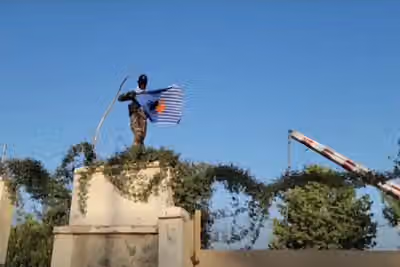
The bill urges the United States and other nations to participate in the Vienna meetings.
Several anti-Taliban groups, including the National Resistance Front led by Ahmad Massoud, have held multiple meetings in Vienna, Austria. The most recent session in June brought together 70 opposition figures to discuss "political unity and a clear, common future for free Afghans”.
Burchett described the Vienna Process as an inclusive platform for anti-Taliban political forces. In a statement, he said, “This bill condemns the Taliban as a terrorist organisation and urges the US to engage in the Vienna Process while encouraging other nations to join as well."
While US and European representatives have maintained contact with the Taliban, they have kept their distance from the National Resistance Front and other opposition groups. However, in a recent development, Michael McCaul, Chairman of the House Foreign Affairs Committee, met with representatives of the National Resistance Front in Washington just a day prior.
The bill outlines that the Vienna meetings have the potential to create a "unified front against the Taliban and pave the way for lasting peace and stability in Afghanistan”. Burchett has urged the House to forward this proposal to the US State Department and the United Nations to rally support for the Vienna process.
The Taliban announced that Mullah Hasan Akhund, the group's Prime Minister, and Gurbanguly Berdimuhamedow, the President of Turkmenistan, inaugurated the TAPI project along with other development projects between Afghanistan and Turkmenistan in the city of Mary on Wednesday.
According to the Taliban, the President of Turkmenistan participated in the ceremony via video conference.
The Taliban’s Prime Minister, along with a delegation, travelled to Turkmenistan on Wednesday morning. In a statement, the Taliban expressed congratulations to the people of Afghanistan and Turkmenistan on the historic inauguration of the TAPI project.
During the ceremony, Mullah Hasan Akhund remarked that the launch of TAPI and the development projects in oil, gas, energy, and transport sectors reflect the goodwill and wise policies of Turkmenistan’s national leadership and officials. He emphasised that these projects will strengthen the friendship between Afghanistan and Turkmenistan, instructing Taliban officials to work with "integrity, dedication, and tireless effort" to complete the projects.
According to the Taliban, President Berdimuhamedow stated during the video conference that friendly, brotherly, and good-neighbourly relations between the two countries are expanding. He highlighted the importance of these projects not only for the benefit of Turkmenistan and Afghanistan but for the entire region. He further noted that cooperation with the Afghan people in economic, political, and diplomatic fields is a key component of Turkmenistan’s policy.
The TAPI pipeline, which will transport gas from Turkmenistan through Afghanistan to Pakistan and India, is one of the region's largest infrastructure projects. The pipeline stretches 1,821 kilometres with an annual capacity of 33 billion cubic metres of gas. The Taliban stated that Afghanistan's annual revenue from transit fees will be $400 million.
In 2017, Afghanistan’s former President Ashraf Ghani, Turkmenistan’s President Gurbanguly Berdimuhamedow, Pakistan’s Prime Minister Shahid Khaqan Abbasi, and India's former Minister of State for External Affairs, MJ Akbar, officially inaugurated the project in Mary, Turkmenistan. At that time, the Taliban had expressed support for the project, pledging to ensure its security in areas under its control.
A group of women took to the streets in western Kabul on Wednesday to protest against the Taliban's policies toward women.
Members of the "Afghanistan Movement to Change Women's History" marched, chanting slogans against the Taliban, labelling the group as "terrorists," and called for the overthrow of the Taliban government.
The women, emphasising on equal rights for both men and women, chanted slogans such as "Taliban commits crimes, and the world supports them”. They also reiterated the popular slogan "Woman, Life, Freedom”.
According to a video obtained by Afghanistan International, these women called on the international community to condemn the Taliban.
The Movement issued a statement, saying that Afghan women have been enduring and fighting in the harshest conditions for three years. The statement highlighted that their struggles have been met with "imprisonment, flogging, execution, rape, and stoning”.
This movement has called on the international community and human rights organisations to pressure the Taliban to prevent mass executions of Afghan citizens.
The movement noted that, despite most Taliban leaders being on international blacklists, they travel freely to various countries. The group added that the Taliban member’s unrestricted travel has emboldened them, and they are now attempting to seize Afghan diplomatic missions abroad.
These women declared that the Taliban lacks both domestic and international legitimacy, and handing over Afghanistan’s diplomatic missions to the group is a "betrayal of individual and social freedoms in Afghanistan”.
The protesting women urged the world to support human rights, freedom of speech, and individual and social liberties for Afghan women in the face of "the Taliban's dictatorship and extremism”. They stressed that this demand can only be fulfilled through the establishment of a democratic government.
The protest concluded in Dasht-e-Barchi, a neighbourhood in western Kabul.
Following the severe repression of women protesters by the Taliban, members of this women movement have continued to protest against the group. The Taliban has used violence, arrests, and threats to suppress all civil activities, including women's protests.
During a debate with Kamala Harris, Donald Trump stated that the Doha Agreement was terminated during his presidency because the Taliban did not adhere to its terms.
Trump said, "We terminated the agreement because they didn’t do what they were supposed to." He also criticised the Biden administration, claiming, "These people executed the worst and, in my opinion, the most shameful withdrawal in the history of our country."
Defending his stance, Trump explained, "We had an agreement, but we didn’t lose soldiers, we didn’t leave many Americans behind, and we didn’t leave $85 billion worth of equipment."
The debate between Kamala Harris and Donald Trump, the leading candidates in the US presidential election, took place on Tuesday, September 10, at 9:00 PM Washington time. In addition to domestic issues, the debate also covered topics such as the Ukraine-Russia war, Israel and Hamas, and Afghanistan.
Trump stated that following the agreement with the Taliban, no US soldiers were killed over a span of 18 months. He added, "I told Abdul Ghani Baradar to stop killing our soldiers, or it would cause trouble for you, and after that, for 18 months, no soldiers were killed."
The Doha Agreement was signed in 2020 during Trump’s presidency. Trump criticised the Biden administration for not adhering to the terms of the agreement, saying, "It was a conditional, phased agreement, but it wasn’t upheld."
Kamala Harris strongly criticised Trump’s handling of Afghanistan. She accused Trump of bypassing the Afghan government and "negotiating directly with a terrorist organisation called the Taliban”.
In response, Trump defended his actions, stating, "I negotiated with the Taliban because they were killing Americans."
Harris avoided directly addressing the question of whether she was responsible for the chaotic withdrawal from Afghanistan, instead stating, "I agreed with Biden’s decision to withdraw from Afghanistan." She continued, saying that four presidents had promised to do it, and Biden finally made it happen. As a result, "American taxpayers are no longer paying $300 million a day for that endless war."
Harris described the US-Taliban agreement made during Trump’s presidency as one of the weakest agreements ever. She added, "Trump calls himself a dealmaker, but even his own advisors said this was a weak and terrible deal."
She further criticised Trump for negotiating with the Taliban and inviting them to Camp David, a place symbolic of American democratic values.
The Doha Agreement was signed in 2020 between the US and the Taliban in Qatar, where both sides agreed on the withdrawal of US troops from Afghanistan.
Michael McCaul, Chairman of the US House Foreign Affairs Committee, and other critics argue that the US left Afghanistan unconditionally, without a settlement between the Taliban and the Ashraf Ghani government, paving the way for the collapse of the Afghan government.
On Sunday, September 8, in an interview with CBS, McCaul called the Doha Agreement a mistake by Zalmay Khalilzad and said it had a negative impact on the morale of the previous Afghan government.
In response, Zalmay Khalilzad called McCaul’s statements a "false accusation" and said that the Doha Agreement provided the basis for "historic negotiations" between the Ashraf Ghani government and the Taliban.
The Taliban has announced that its leader, Hibatullah Akhundzada, recently visited the provinces of Sar-e-Pul, Baghlan, and Samangan.
During his visit to Sar-e-Pul, Akhundzada stated that there would be "no leniency" in fully enforcing the group’s interpretation of Sharia law.
He emphasised that any law that contradicts "Islamic beliefs" would not be accepted. While the exact date of his visit is unclear, the Taliban reported on Tuesday that their reclusive leader had travelled to several northern provinces of Afghanistan.
According to Taliban-controlled Bakhtar News Agency, Salam Hanafi, the Uzbek deputy prime minister, accompanied Akhundzada on the visit to Sar-e-Pul. In remarks attributed to Hibatullah, he reiterated that the Taliban's war was aimed at enforcing their interpretation of Sharia, establishing justice, and eradicating corruption.
"In implementing Sharia and ensuring justice, I will not show tolerance or compromise with anyone, so that the divine law is implemented one hundred percent in this land," Hibatullah reportedly said.
During a previous visit to Faryab, the Taliban leader also stressed on the importance of enforcing Sharia punishments. Over the past three years, the group has implemented strict laws, including public floggings, and justified the ban on women’s education and work on religious grounds.
Western countries, as well as some Islamic and regional nations, have urged the Taliban to revise their policies, particularly those related to women's rights. Hibatullah's latest comments appear to be a response to these requests.
Previously, other senior Taliban officials, particularly the Minister for the Propagation of Virtue and Prevention of Vice, stated that adhering to their version of Sharia law was a red line for the Taliban government.
Western governments, human rights organisations, and international bodies have called for an end to the Taliban's harsh Islamic punishments, such as stoning, amputation, and flogging, stating that these practices violate international human rights standards and Afghanistan's global commitments.
These organisations argue that such severe punishments not only contradict human principles but also have the potential to negatively impact Afghan society.
Afghans residing in Norway have issued a statement criticising the Norwegian Ministry of Foreign Affairs' decision to close the Afghan Embassy in Oslo.
These citizens called on Norway to stop "concealing and legally and socially justifying the Taliban" in order to engage with the group and recognise the "terrorist administration" in Afghanistan.
The Afghan Embassy in Norway announced that it would close its doors on Thursday, September 12, following the host nation's directive.
Afghan citizens in Norway, in a joint statement, expressed concerns that this decision would create numerous challenges for Afghans, Norwegian citizens, and other individuals.
Afghan citizens further demanded that diplomatic, consular, and administrative work at the embassy continue until a national inclusive government is formed to address the needs of those seeking assistance.
The statement added, "We do not expect Norway, with its distinguished record of human rights, democracy, and value-based politics, to become complicit in the hidden games of international terrorism, and we call for the preservation of its international reputation."
The Afghan community reiterated their recognition of the Taliban as "a terrorist group”.
This marks the second Afghan embassy in Europe to be closed by the host nation. Earlier this week, the Afghan Embassy in London also announced its closure on orders from the UK government.
The decision comes after the Taliban administration announced that it no longer recognised diplomatic missions set up by the former government and that documents issued by embassies in Norway and 13 other mostly European countries were invalid.