Pakistan Arrests Former Al-Qaeda Leader Aide In Punjab Province

The Punjab Counter-Terrorism Department announced the arrest of Amin Muhammad Ul Haq Saam Khan, an aide to Osama bin Laden, the former leader of al-Qaeda, in Punjab.

The Punjab Counter-Terrorism Department announced the arrest of Amin Muhammad Ul Haq Saam Khan, an aide to Osama bin Laden, the former leader of al-Qaeda, in Punjab.
In a statement released on Friday, the department stated that Amin ul-Haq was involved in numerous terrorist activities.
Dawn, Pakistani newspaper, reported that Amin ul-Haq's name is on the UN's global terrorist list.
Pakistan has described the arrest of Amin ul-Haq as a significant breakthrough in the fight against terrorism in Pakistan and globally.
The Punjab Counter-Terrorism Department said that this senior Al-Qaeda leader was planning a large-scale terrorist project.
Osama bin Laden was killed in 2011 during a US raid on his hideout in the Abbottabad city of Pakistan.
According to a report by Afghanistan International published in September 2021, Amin ul-Haq entered Afghanistan shortly after the Taliban seized control of Kabul. A video circulating on social media at that time showed a convoy transporting Amin ul-Haq from Pakistan to Nangarhar province.

Afghanistan United Front (AUF) claimed that Esmail Qaani, commander of Quds Force, in a secret meeting with representatives of Al-Qaeda and Taliban, had stated that Iran is willing to fund Al-Qaeda's activities in Afghanistan and Middle East.
Qaani mentioned that their common goal is to expel the United States from the Middle East.
The Afghanistan United Front led by Sami Sadat, reported that the agreement to fund Al-Qaeda's military operations was made during a meeting in October 2021, attended by the current leader of Al-Qaeda, senior Taliban representatives, and the commander of the Quds Force.
According to the report, Esmail Qaani, commander of the Quds Force, the external branch of Iran's Islamic Republic Guards Corp (IRGC), Saif al-Adel, former global operations commander of Al-Qaeda and the current leader of the network, and senior Taliban representatives were present at the meeting in Tehran.
This was the first meeting between the IRGC commander, the leader of Al-Qaeda, and senior Taliban representatives in Tehran.
AUF’s report stated that during this meeting, Qaani congratulated the Taliban on their victory in Afghanistan and added that they accomplished a great task, and it was time to focus on expelling US forces from the Middle East.
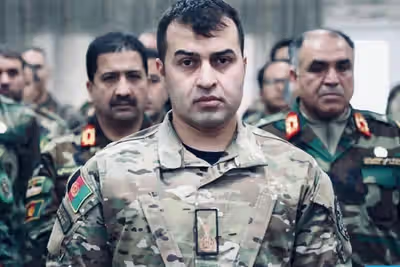
Sami Sadat, a former Afghan army commander who went to the US after the fall of the Afghan government, later founded the Afghanistan United Front with several other Afghans.
This week, the group prepared an intelligence assessment of Al-Qaeda's activities in Afghanistan and worldwide, a copy of which was provided to Afghanistan International.
The report did not specify the sources or the organisations with which this assessment was prepared.
The Afghanistan United Front stated that senior IRGC and Al-Qaeda representatives agreed on cooperation and peace between Iran's proxy groups and Al-Qaeda branches in the Middle East and Africa. According to the report, "Peace was established between the Houthis and Al-Qaeda in the Middle East, and coordination was achieved with Hezbollah and militia groups in Iraq and Syria."
The group also claimed that the increased presence of Al-Qaeda in Afghanistan is a result of the agreement between the Taliban, Iran, and Al-Qaeda.
The report stated, "It was agreed that the Taliban would provide space and tools for training Al-Qaeda's combat forces in Afghanistan. The IRGC is ready to cover all of Al-Qaeda's expenses in Afghanistan and the network's overseas operations in the Middle East and Africa."
After the fall of the first Taliban government in Afghanistan in 2001, Al-Qaeda fighters and part of Osama bin Laden's family, the former leader of Al-Qaeda, resided in Iran.
In February 2023, the US Department of State announced that Saif al-Adel, an Egyptian Islamist, was in Iran and had assumed leadership of Al-Qaeda after the death of Ayman al-Zawahiri, the former leader of the group.
In the same month, the UN sanctions monitoring team reported that the overwhelming majority of the team's members believed that Saif al-Adel, who had been operating in Iran under the protection of the Islamic Republic for years, was the current leader of Al-Qaeda.
The US Department of State has offered a $10 million reward for information leading to Saif al-Adel due to his role in the attacks on US embassies in Africa.
Iran has denied the presence of the Al-Qaeda leader within its borders, calling it part of the US “Iranophobia” campaign.
AUF reported that after the three parties' meeting and commitments, Al-Qaeda's recruitment and training centres have significantly increased in Afghanistan, and the terrorist group's financial capacity in the Middle East and Africa has been strengthened.
The report added, "Since early July, the IRGC has been closely cooperating with Abdul Rahman al-Maghrebi, Al-Qaeda's second-in-command, to arm and support Ibrahim al-Banna, the new Al-Qaeda leader in the Middle East, to increase attacks in the Red Sea and target Saudi Arabia and the United Arab Emirates."
According to the report, in June 2022, the IRGC commander asked Saif al-Adel, the current leader of Al-Qaeda, to attack Israeli embassies and intelligence agencies in the UAE. Iran was supposed to provide the explosives, while Al-Qaeda would be responsible for the operational force.
Following these increased threats, Israeli diplomats and intelligence officers were forced to leave the UAE.
The Afghanistan United Front stated that Iran believed its nuclear scientists and military commanders were being targeted by Israeli intelligence based in the UAE.
According to the report, in January 2024, as the US and British navies increased pressure on the Houthis, the IRGC asked Al-Qaeda to plan attacks on US and British embassies.
The task was given to Khalid Batarfi, the leader of Al-Qaeda in the Arabian Peninsula, but he died a month later from an unknown illness. The report added that the attack has been postponed but not cancelled.

Donald Trump, the Republican party's nominee for the US president, criticised the withdrawal of US troops from Afghanistan during Joe Biden's presidency and called it "shameful" and stated that the forces did not withdraw according to his plan.
Trump asserted that under his plan, the US would not have left Afghanistan until the Taliban fulfilled their promises.
During a speech on the fourth day of the Republican National Convention, Trump said, "I spoke with the Taliban leader, and he called me 'Your Excellency’”.
He added, "I warned the Taliban leader that if you kill one American, we will hit you harder than ever before in history."
Trump claimed that the group did not dare to attack American soldiers for 18 months.
He also recalled that during the withdrawal of US forces from Afghanistan on August 30, 2021, 13 American soldiers were killed and 45 others were injured.
Trump criticised Joe Biden's administration, stating that the US left behind $85 billion worth of equipment during the 2021 withdrawal, which the Taliban are now "selling”.
He also mentioned that the US not only left these weapons but also evacuated Bagram Air Base, which he claimed is now used by China.
Trump concluded by saying that his plan was for US forces to leave Afghanistan gradually and conditionally.

Local sources in Bamiyan have told Afghanistan International that at least two villagers had been injured during clashes between nomads and villagers in Punjab District.
According to these sources, one of the injured individuals was shot, while the other sustained a head injury after being hit by a stone.
The injured have been transferred to Punjab Hospital, with the condition of the person with the head injury "concerning”.
Witnesses also stated that the Taliban deleted video recordings of the clash from locals' mobile phones and prohibited interviews, as well as taking of photos and videos of the injured.
Some sources suggest that the number of injured could be higher than initially reported, but Afghanistan International has not yet been able to verify this.
The clash occurred in the "Darazqul" area along the Ghor-Kabul highway when nomads brought their sheep to graze in the villagers' fields and pastures, leading to a confrontation.
This incident took place just two days after Mullah Noorullah Noori, the Taliban's Minister of Borders and Tribal Affairs, announced in a meeting with Mullah Abdul Kabir, the group's Deputy Prime Minister for Political Affairs, that "the issue of pastures between the Hazara people and the nomads has been resolved through a plan agreed upon by both sides”.
Local sources in Hazarajat are yet to confirm that the disputes between the nomads and villagers have been resolved as per the agreement. Furthermore, the recent clash in Punjab highlights ongoing tensions between the two groups.
Last year, Mullah Abdul Kabir stated that a solution for the conflict between the nomads and the Hazaras would be found based on Islamic Sharia and law.
Following the statements from Taliban leaders last year, several members signed and published a document forming the "Commission for Resolving Conflicts between Nomads and Local Residents”.
This document, comprising six articles, permitted the nomads access to areas where they claimed land ownership. If villagers had any disputes, they were directed to refer to the Taliban authorities.
The document also emphasised that until the Taliban's Commission for Resolving Conflicts settles the disputes over pastures and lands, neither side is allowed to occupy the disputed areas.

On Thursday, the Taliban's Ministry of Energy and Water announced the signing of three agreements for solar power generation projects valued at $25 million with a private company.
According to the Taliban, these projects will generate eight megawatts of electricity in Paktika, Uruzgan, and Farah.
Abdul Latif Mansour, the Taliban's Minister of Energy and Water, and Haji Pahlawan, the head of the private company "Awfi Bahram Mining" signed these agreements on Thursday.
Due to a lack of access to electrical energy, Afghanistan relies heavily on fossil fuels and generators, and it is significantly dependent on neighbouring countries for its energy needs.
The country meets 75% of its electricity needs from Uzbekistan, Turkmenistan, and Iran, spending millions of dollars annually.
In late 2023, the United Nations announced that Afghanistan is facing a major energy crisis, with only 40% of households in the country having access to electricity.

Abdullah Mobini, the head of Iran's National Migration Organisation, announced the launch of a "comprehensive system" for migrants.
Mobini stated that this system was established to facilitate access to comprehensive and complete statistics on foreign nationals and migrants.
According to Iranian media, this Iranian official announced the launch of this system during a meeting in Kerman on Thursday.
He mentioned that alongside launching this system, the Islamic Republic of Iran is simultaneously advancing several important initiatives, including border control, visa reform, job atlas, stricter penalties, a bail plan, smart traffic plan, student and school initiatives, micro-deposits, large-scale investments, and organising smart cards.
Afghans constitute the largest population of foreign migrants in Iran.
Previously, the Bureau for Aliens and Foreign Immigrants Affairs in Kermanshah province announced the prohibition of accommodation, and employment of Afghan migrants in 16 provinces.
East Azerbaijan, West Azerbaijan, Ardabil, Zanjan, Kurdistan, Kermanshah, Ilam, Lorestan, Chaharmahal and Bakhtiari, Kohgiluyeh and Boyer-Ahmad, Gilan, Mazandaran, Sistan and Baluchestan, Hormozgan, and Hamedan are the provinces where the settlement and employment of Afghans have been banned.
In October 2023, over 540 artists, lawyers, doctors, journalists, and civil and social activists in Iran called for an end to the harassment of Afghan migrants in Iran.
They stated that Iran's legal system in recent years has created the most significant obstacles and challenges to the integration of migrants into the host society.