Human Rights Activist Declines UN Invitation To 3rd Doha Meeting
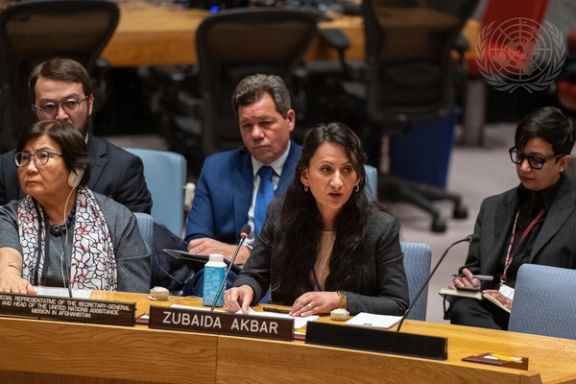
Zubaida Akbar, a human rights activist, has announced that she received an invitation from the United Nations to participate in the Doha meeting, but has decided not to attend it.

Zubaida Akbar, a human rights activist, has announced that she received an invitation from the United Nations to participate in the Doha meeting, but has decided not to attend it.
Akbar expressed her anger over the UN's decision to exclude women from the main table of discussions in Doha.
Human rights activists report that the UN has removed women from the composition and agenda of the main Doha meeting. However, according to them, "Some women and civil society activists" will be invited to meet with special representatives of countries in smaller meets. It is still unclear who exactly has received invitations from the UN.
Akbar wrote on the X social media platform, "I am outraged by the UN's decision to exclude women from the Doha 3 on Taliban’s terms." She added that the Doha meeting, without women, achieves nothing but appeasement for the Taliban.
According to this human rights activist, considering that Afghanistan is experiencing the most serious women's rights crisis in the world, the issue of women should have been a priority on the Doha meeting agenda.
The Taliban will send their representatives to Qatar late next week to attend the two-day meeting in Doha with senior UN officials and special representatives from 25 countries for Afghanistan.
This is the third meeting led by the UN and the first meeting to include Taliban officials. However, the exclusion of women and civil society representatives from the main meeting has sparked widespread criticism.


Rosemary DiCarlo, the UN Under Secretary-General, stated on Wednesday during a meeting with Afghanistan International and four other news agencies that the third Doha meeting will not discuss recognising the Taliban government.
Responding to criticisms about the exclusion of Afghan women and civil society, she said, "This is not an intra-Afghan meeting."
DiCarlo emphasised, "I want to stress that the Doha meeting is a process. We have been heavily criticised for not including Afghan women and civil society in the discussions. I must clarify that this is not an intra-Afghan dialogue."
She added, "I hope we will reach that point someday, but we are not there yet."
The Under Secretary-General is scheduled to meet with Afghan women and civil society representatives on the second day of the Doha meeting on July 1.
Representatives from 25 countries have been invited to this meeting. DiCarlo noted that engaging with the Taliban does not equate to recognition.
"This is not a recognition meeting. This meeting will not lead to the recognition of the Taliban... Engaging does not mean recognising. This meeting is not about the Taliban; it is about Afghanistan and its people."
The Taliban had stipulated the exclusion of civil society and women's representatives as a condition for their participation in the Doha meeting, which was accepted by the UN.
DiCarlo mentioned that the Taliban had requested a meeting with António Guterres, the UN Secretary-General.
She explained that since she is chairing the meeting, it will not be possible for the Taliban delegation to meet with the UN Secretary-General in Doha.
DiCarlo emphasised that the goal of the Doha meeting is to commit the Taliban to international laws and the UN Charter. She expressed hope that the UN will achieve this step by step.

Sources told Afghanistan International that a meeting to support Afghan women will be hosted by the Belgian delegation at the United Nations on Thursday.
The meeting will focus on how to increase global support for Afghan women and the necessity of including women and civil society representatives in the Doha meeting.
Two credible sources informed Afghanistan International that Afghan activists will speak with diplomats from various countries at the UN during this meeting, which will be held both in-person and virtually.
The meeting, titled "Together in Support of Afghan Women: Women's Rights Are Non-Negotiable," will invite ambassadors, special representatives for Afghanistan, human rights organisations, and media outlets.
On Tuesday, sources also reported that a "confidential" virtual meeting was held with Rosemary DiCarlo, the UN Deputy Secretary-General, along with several female activists and civil society representatives from Afghanistan. DiCarlo emphasised on the importance of satisfying Afghan women and civil society.
The third Doha meeting, chaired by Rosemary DiCarlo and attended by special representatives from various countries and a Taliban delegation, is set to take place in a few days.
The Taliban managed to change the agenda and composition of the Doha meeting, resulting in the exclusion of Afghan women and civil society representatives from the main session.
The exclusion of women and civil society from the third Doha meeting has sparked outrage among human rights defenders and dissatisfaction among powerful Western countries.

Local sources confirmed that Taliban fighters clashed with residents in Khash district of Badakhshan province on Wednesday. The conflict erupted due to the eradication of poppy cultivation in the province.
The conflict erupted due to the eradication of poppy cultivation in the province.
Sources told Afghanistan International that several local residents were injured in the clash, and the Taliban fighters fled the scene.
The clash occurred on Wednesday morning, resulting in four local residents being injured, with one in critical condition.
Sources stated that Taliban fighters from Badakhshan and Kunduz had been dispatched to Khash district to destroy the poppy fields, but fled after the confrontation.
According to the sources, the Taliban members seize the collected opium from the locals and sell it openly in the market.
Images provided to Afghanistan International show local residents transporting the injured.
So far, Taliban officials have not commented on the incident.
In recent months, Badakhshan has witnessed widespread protests against the Taliban. These protests, which lasted several weeks, began due to the eradication of poppy fields by the Taliban.

On the final day of the Vienna meeting, opponents of Taliban stated that setting the Doha meeting's agenda according to the Taliban's demands and the group's unilateral participation indicates that the UN has deviated from its primary mission.
In a declaration, they warned against any engagement and normalisation of relations between the international community and the Taliban.
The final declaration of the Vienna conference stated, "The unilateral participation of the Taliban and setting the agenda according to their wishes not only delegitimizes the Doha meeting, but also the entire Doha process."
The Taliban opponents called on UN Secretary-General António Guterres to act responsibly considering the sensitivity of the Afghan issue.
The participants of the Vienna conference described the human rights situation in Afghanistan as dire, citing the restrictions on women, the denial of their right to education, and their removal from public life as clear examples of gender apartheid and crimes against humanity.
They urged the international community and independent organisations to recognize gender apartheid and facilitate the prosecution and accountability of Taliban leaders responsible for such conditions.
Several politicians, civil activists, and human rights advocates gathered at the fourth Vienna meeting to discuss various issues concerning Afghanistan.
On Wednesday, the participants called for addressing the current multilayered crisis in Afghanistan, stating that the Taliban are trying to perpetuate their illegitimate rule through intimidation and torture.
They described Afghanistan's security situation as fragile, deteriorating, and unstable, calling for the mobilisation of forces opposing the Taliban.
The four working groups of the Vienna meeting proposed strategies for transitioning to a democratic, stable, and legitimate Afghanistan. They emphasised on the importance and necessity of neighbouring countries' support and coordination for transitioning to a secure, democratic, and humane Afghanistan.
The participants of the Vienna meeting called on regional countries to refrain from cooperating with the Taliban in mining activities, stating that minerals are a national asset and should only be utilised by a legitimate government representing the people.

Twelve prominent female leaders have stated that excluding women from the Doha meeting and yielding to the Taliban's conditions will legitimise the group and lead to further oppression of women in Afghanistan.
In an open letter to the international community, these leaders, participants at the 2024 Global Women Leaders Summit, called for the active and direct participation of Afghan women in the third Doha meeting.
The letter was signed by former US Secretary of State Hillary Clinton, former Presidents of Lithuania and Kosovo, former Prime Ministers of Finland, New Zealand, and Australia, former Foreign Minister of Mexico, and the former head of the Afghanistan Human Rights Commission, among others.
These women stated that the international community’s exclusion of Afghan women is "outrageous" and will marginalise their voices and undermine their rights.
The leaders stated, "Afghan women’s exclusion is inconsistent with the UN Charter, UN Security Council Resolution 1325 on Women, Peace, and Security, and nine subsequent related resolutions, and conventions including the Convention on the Elimination of All Forms of Discrimination against Women (CEDAW)."
The prominent international figures emphasised that ignoring women at the upcoming Doha meeting contradicts the global stance on Afghan women's rights and undermines the credibility and effectiveness of the Doha meeting.
They declared that the international community should not pave the way for the broader legitimacy of the Taliban.
The female leaders stressed, "The status and rights of women are fundamentally relevant to all discussions. We must not open a pathway for the Taliban to gain broader legitimacy, including for its oppressive treatment of women. Allowing the Taliban to dictate the terms of the Doha dialogue legitimises their draconian abuses, which amount to gender apartheid."
They asserted that this is a decisive moment for the international community to show its unwavering commitment to Afghan women and girls by insisting on their presence at the negotiating table.
The Doha meeting will be held in a few days with the participation of special representatives from regional and international players.
A Taliban spokesperson will head the group's delegation at the Doha meeting, which will be chaired by the UN Deputy Secretary-General.