Decision of Recognising Government Rests on People Of Country, Says Iran
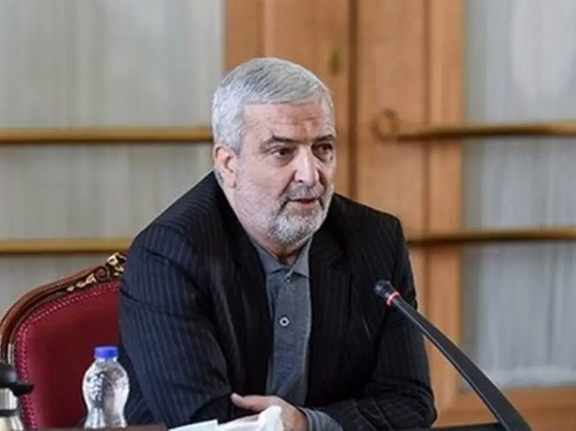
Hassan Kazemi Qomi, Iran's Special Representative for Afghanistan, has emphasised that the recognition of governments is a matter for the people of each country to decide.

Hassan Kazemi Qomi, Iran's Special Representative for Afghanistan, has emphasised that the recognition of governments is a matter for the people of each country to decide.
In an interview with TOLOnews, Qomi stated that Iran will support the will of the Afghan people.
He also mentioned that the appointment of a new United Nations representative, with clearly defined powers, should be welcomed, if it helps Afghanistan's situation.
Qomi highlighted that developments in Afghanistan have a significant impact on the national security interests of neighbouring countries, adding, "To solve the problems in Afghanistan and address concerns about terrorism, a regional consensus and joint cooperation between countries is needed."
Like other countries, the Islamic Republic of Iran does not recognise the Taliban as the legitimate government, but it maintains diplomatic and economic relations with the group and has handed over the Afghan embassy in Tehran to the Taliban.


The Taliban's Ministry of Mines and Petroleum announced that the Chinese MCC company, which holds a contract for the Aynak copper mine, is interested in "investing in other major mines" in Afghanistan.
Shahabuddin Delawar, the Taliban's Minister of Mines, has said that the Taliban will only agree to further investments from this company if mineral processing is conducted within Afghanistan.
On Sunday, the Taliban's Ministry of Mines and Petroleum wrote on the social media platform X that the president of the MCC company had met with Delawar in Kabul.
The Chinese company is one of the largest firms involved in the extraction and processing of copper, lead, and zinc. According to the Taliban's Ministry of Mines and Petroleum, this company is particularly interested in investing in Afghanistan's major mines, especially those of copper, lead, and zinc.
Delawar, while welcoming the company's interest, informed the president of the company about the lead and zinc mines in Bamiyan, Ghor, and Kandahar.
The state-owned MCC obtained the license for the Aynak copper mine nearly two decades ago, but has not commenced extraction due to security concerns.
The Taliban members have repeatedly called for extraction at this major mining site to begin, but the Chinese company has refrained to do so and has not provided an explanation.
The Taliban's Ministry of Mines stated that during Sunday's meeting, Delawar gave "necessary directives to the MCC company to expedite activities at the Aynak copper mine”.
Taliban officials have frequently stated that security conditions have improved to facilitate foreign companies' investments in Afghanistan. However, these assurances do not appear to have convinced Chinese companies, despite their government's close relationship with the Taliban.

Hibatullah Akhundzada, the leader of the Taliban, in an audio message attributed to him, has instructed his security commanders in Kandahar to seriously investigate the presence of ISIS-Khorasan in the region.
Akhundzada also directed that he should be informed if any Taliban officials interfere with the duties of the security commanders.
The Pashto section of Afghanistan International reported on Sunday that they had obtained this audio message in which the Taliban leader was speaking to the commanders via a radio communication device.
A reliable source confirmed that Mullah Hibatullah spoke with Taliban security commanders from various districts, security organisations, and some members of the group's military in Kandahar.
The source further added that Mullah Hibatullah instructed all officials to closely monitor ISIS activities in their areas and conduct security assessments regarding potential threats.
Although the Taliban has not yet commented on Mullah Hibatullah's communication with Kandahar security officials, this is the first time the leader has been known to communicate with security officials through an audio message that has been publicly released.
Following an ISIS suicide attack outside a Kabul Bank branch in Kandahar on March 21 this year, which killed at least 43 people and injured 45 others, the Taliban government has increased security measures in Kandahar. Local sources also report an increase in security checkpoints throughout the city.

The Afghanistan national futsal team has successfully qualified for the Futsal World Cup after defeating Kyrgyzstan with a score of 5-3. Goalscorers for Afghanistan included Omid Qanbari, Akbar Kazemi, Mahdi Noruzi, and Mehran Gholami, who scored twice.
Reactions to the qualification have been overwhelmingly positive. The Taliban spokesperson extended congratulations to Afghanistan's futsal team on their World Cup qualification, declaring it a significant achievement.
Additionally, former officials such as Ashraf Ghani, Abdullah Abdullah, and Atta Mohammad Noor, among others, offered their praises separately, applauding the team for this historic accomplishment.
Ahmad Massoud, the leader of the National Resistance Front also expressed his commendation, telling the team members, "After a long time, you have brought joy to the hearts of our suffering people. You are our pride."

The United Nations Children's Fund (UNICEF) has reported that in 2024, approximately 23.7 million people in Afghanistan, including 12.3 million children, are in urgent need of humanitarian aid.
As of now, only 35 percent of the necessary USD 1.4 billion funding for these children has been secured.
The organisation's latest report, released in March, details the humanitarian situation in Afghanistan. It identifies prolonged conflicts, climate change, economic downturn, and rising unemployment as critical drivers of poverty in the region.
The report documents significant healthcare challenges in Afghanistan, with 14,570 suspected measles cases and 71 related deaths recorded since the start of the year. Notably, over 11,000 of these cases involve Afghan children under five years old, and more than 6,000 are women.
Recent heavy rainfall on March 29 and 30 has exacerbated the situation, destroying more than 1,500 acres of arable land and over 500 houses across various provinces, according to this UN agency.
In March alone, 17 incidents were documented concerning women’s participation and restrictions in humanitarian programmes. UNICEF has urged its humanitarian partners to ensure the safety of female staff operating in the country.
These developments come amidst ongoing concerns by organisations such as Save the Children, which recently highlighted the plight of 250,000 Afghan children who have returned from Pakistan, now facing acute shortages of food and shelter in Afghanistan.

Polio Free Afghanistan has declared that a nationwide campaign to vaccinate children against polio will commence on Monday across all provinces of Afghanistan.
According to a statement released on Sunday by the organisation, children will also receive vitamin A supplements during the vaccination drive.
Polio Free Afghanistan urges parents to ensure their children receive vitamin A to bolster their resistance to various diseases.
Afghanistan and Pakistan remain the only two countries worldwide where polio has not yet been eradicated.
The World Health Organisation has previously expressed concern that the forced repatriation of Afghan migrants from Pakistan, coupled with extensive population displacements, may heighten the risk of polio spread within Afghanistan.