Afghanistan One of Most Perilous Countries for American Citizens, Says US State Department
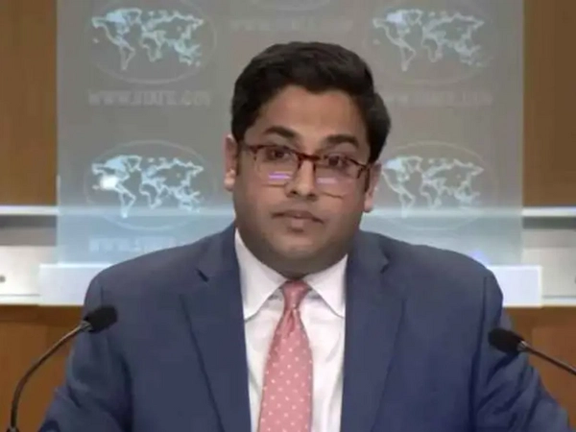
The US State Department, through Deputy Spokesperson Vedant Patel, has declared Afghanistan as one of the most perilous countries for American citizens.
The US State Department, through Deputy Spokesperson Vedant Patel, has declared Afghanistan as one of the most perilous countries for American citizens.
Patel stressed on the paramount importance of safeguarding US nationals, particularly those in captivity or facing hostage situations.
During a recent press conference, Patel informed Afghanistan International journalist Marzia Hosseini about the US' dedicated efforts, spearheaded by the special representative for hostage affairs, to secure the release of Americans held by the Taliban.
Since the Taliban's ascent to power two years ago, many countries, with the US leading the charge, have strongly discouraged their citizens from traveling to Afghanistan.
Earlier, the State Department specifically warned against travel to Afghanistan, citing severe threats such as terrorism, unlawful detentions, kidnappings, and criminal activities.
Secretary of State Antony Blinken has acknowledged the detention of several US citizens by the Taliban and disclosed ongoing efforts by the US government for their liberation and safe return.
However, detailed statistics regarding the number of Americans detained by the Taliban remain undisclosed by the US.

Mujib Khilwatgar, head of Nai, a prominent organisation supporting free media in Afghanistan, has announced a temporary halt to its activities in the country.
Khilwatgar indicated that he will elaborate on the reasons for this suspension at a later date.
Established in 2005, Nai has been committed to its mission of fostering a free media landscape, as Khilwatgar expressed in a recent video message.
The Taliban spokesperson previously declared that Nai, operating externally, lacks the legitimacy to comment on Afghan media affairs, thereby denying it official recognition.
Khilwatgar voiced his aspiration for Nai's future operations, contingent on positive developments in Afghanistan's political and social environment. He cited the challenging current political climate and unfavourable conditions in Afghanistan as the primary reasons for this pause in operations.
Following this announcement, Khilwatgar emphasised that no individual is authorised to represent Nai in Afghanistan, in either a real or nominal capacity.
In his address, Khilwatgar reflected on the ongoing hardships faced by Afghanistan. Nai, known for its advocacy and extensive reporting in support of journalists, has played a critical role in the Afghan media sector.
Post the Taliban's ascension to power in 2021, a significant number of media outlets ceased operations, and numerous journalists were forced to leave Afghanistan. Over the past two years, Nai has actively responded to instances of journalist detentions by the Taliban through official statements. Despite these challenges, Nai has maintained a non-confrontational stance towards the Taliban, referring to them as 'officials' in its communications.
Mullah Abdul Kabir, the Taliban's Deputy Prime Minister for Political Affairs, has announced that their representative has been invited to the forthcoming Doha meeting on Afghanistan.
The second United Nations conference, involving special representatives from various countries, is scheduled to be held in Qatar starting from February 18 to February 19.
The Taliban’s Prime Minister's office stated on Thursday that Mullah Abdul Kabir met Paul Klouman Bekken, Chargé d'Affaires at the Norwegian Embassy in Afghanistan. The Norwegian diplomat confirmed that the Doha meeting about Afghanistan is planned for February 18, and the Taliban's representative is expected to attend it.
UN spokesperson Stéphane Dujarric, in a press briefing on Wednesday, had said that the aim of the Doha meeting is to align different nations' approaches towards Afghanistan and discuss independent assessments of the country.
The first UN meeting in Doha, hosted by UN Secretary-General António Guterres, took place on May 1. Representatives from the USA, European Union, Russia, and Afghanistan's neighbours attended the meeting, but the Taliban and opposition forces had not been invited.
During his meeting, Mullah Abdul Kabir expressed the Taliban's wish for reciprocal respect from the US, Europe, and neighbouring countries. The Taliban's statement noted that the Norwegian Chargé d'Affaires emphasised on the importance of education for girls and women and the creation of job opportunities for them.
The Taliban's Deputy Prime Minister remarked that they are not against the education of women and girls. He noted that a special committee has been established on the Taliban leader's orders to promote education for women and girls.
Kabir encouraged Norway and other European countries to reopen their embassies in Kabul. He also stated that the Tehreek-e-Taliban Pakistan (TTP) has no place in Afghanistan and that ISIS has been subdued.
According to the Taliban's statement, Norway has dedicated 93 million dollars for managing natural disasters in Afghanistan and seven million dollars for aiding migrants returning from Iran and Pakistan.
The United Nations, spearheaded by Secretary-General António Guterres, is set to organise a conference on Afghanistan in Doha on the 18th and 19th of February.
Stéphane Dujarric, the spokesperson for the UN, has confirmed the participation of special representatives from various countries involved in Afghan affairs.
Announced at a press briefing on Wednesday, the conference aims to synchronise the approaches of different nations towards Afghanistan and to deliberate on independent assessments of the situation in the country.
This upcoming meeting follows the first UN-led conference in Doha last May, which saw attendance from representatives of the USA, EU, Russia, and Afghanistan's neighbouring countries. Notably absent from the previous summit were representatives from the Taliban and opposition political forces.
Following the earlier conference, Guterres announced efforts to cultivate a consistent stance on Afghanistan among all participants. However, discrepancies among representatives from different countries were reported, as highlighted by Zamir Kabulov, Russia's Presidential Representative for Afghanistan.
In preparation for this meeting, international human rights organisations have urged the UN to include Afghan women in their discussions on Afghanistan.
Complementing these diplomatic efforts, a regional meeting is slated to occur in Kabul prior to the Doha conference. According to Rasoul Mousavi, Director-General for South Asia at Iran's Ministry of Foreign Affairs, Kabul is set to host a regional meeting next week with representatives from Iran, Pakistan, Russia, and China.
In a joint statement, the presidents of Iran and Turkiye emphasised on the establishment of an inclusive, responsible and responsive government representing all the people in Afghanistan.
Ebrahim Raisi and Recep Tayyip Erdogan, presidents of Iran and Turkiye, called for providing security to the people of Afghanistan "without any ethnic and sectarian discrimination".
On Thursday, the website of the president of Iran published the joint statement.
Raisi went to Turkiye on Wednesday and met his Turkish counterpart Erdogan.
In the statement, it has been stated that both countries assessed the practical and constructive interaction with the current officials of Afghanistan as important.
Despite their relations with the Taliban, Turkiye and Iran do not recognise the group’s government.
Both sides also emphasised on the necessity of fighting against all terrorist groups, drug production and trafficking, human trafficking, and illegal trafficking as well as providing the possibility of safe, voluntary and honourable return of all illegal Afghan immigrants to their country.
The Gaza crisis, the joint fight against all forms and manifestations of terrorism, the fight against smuggling of goods, weapons, drugs, and the fight against organised crime along the common borders, economic and commercial cooperation, and strengthening cooperation in the field of road and rail transit were among other issues raised in this meeting.
Erdogan and Raisi also discussed the increase of "Islamophobia", the Astana process to maintain peace in Syria, respect for the territorial integrity of the countries of the Caucasus region, and other global and regional issues.
The Presidents of the two countries held a two-hour meeting on Wednesday and following the meeting, they attended a joint press conference.
During the press conference, Raisi expressed that the Iranian government views any form of insecurity in the region's countries as a threat to the entire region.
Referring to the war between Israel and Hamas, the Iranian president said that international organisations and the United Nations have lost their effectiveness and cannot prevent the disaster in Gaza.
He mentioned that during his discussion with the Turkish president, both sides emphasised on continuing support for Palestine.
Erdogan also conveyed that he had discussions with Raisi, emphasising on the imperative to halt Israel's attacks on Gaza and urging for prompt measures for the establishment of a fair and enduring peace.
Sergey Lavrov, Russia’s Foreign Minister, has said that Moscow does not recognise the Taliban due to the group’s violation of commitments to human rights, especially women's rights, and the establishment of an inclusive government.
Lavrov also called on the anti-Taliban fronts to strengthen the "peaceful" approach.
In a press conference at the UN headquarters, addressing a question from Maryam Rahmati, a reporter for Afghanistan International, the Russian Foreign Minister stated that the Taliban government is predominantly composed of "all Taliban," lacking representation from other ethnic and religious groups like Hazaras, Tajiks, and Uzbeks.
He clarified that it is not only an issue of ethnic inclusion, but also political and religious inclusion should be considered.
The Russian Foreign Minister further noted that the current stance of the anti-Taliban resistance fronts, particularly active in northern Afghanistan, suggests a reluctance to engage in dialogue with the group. However, he emphasised on the need for concerted efforts in this regard. Lavrov urged individuals with influence over the anti-Taliban forces to encourage them to participate in "peaceful" dialogue.
Lavrov once again mentioned Hamid Karzai, the former president, and Abdullah Abdullah, the former chairman of the High Council for National Reconciliation and said that they are present in Kabul and want to help return the country to the original path.
In a press conference a week ago, the Russian Foreign Minister recognised the National Resistance Front of Afghanistan, led by Ahmad Massoud, active in the country's northern areas. Lavrov stressed the need for dialogue between this front and the Taliban, advocating for a bridging of differences.
Lavrov mentioned Karzai and Abdullah and said that he advises the Taliban to invite other political forces to the ruling structure.