AFF Announces Killing Taliban Member in Kapisa Province

Afghanistan Freedom Front (AFF) announced that the front’s forces have killed a Taliban member In Kapisa province. According to AFF, three other Taliban members have been injured in the attack.

Afghanistan Freedom Front (AFF) announced that the front’s forces have killed a Taliban member In Kapisa province. According to AFF, three other Taliban members have been injured in the attack.
In a statement on Tuesday, AFF stressed that the front launched a rocket attack on the rapid response forces of the Taliban in the capital city of Kapisa province.
The Taliban have not responded to AFF yet.
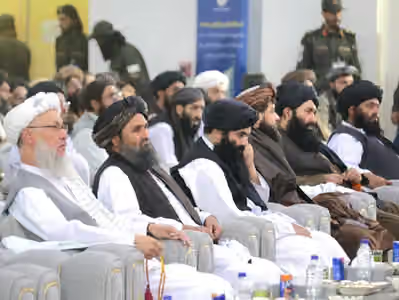

Pakistan Prime Minister Shahbaz Sharif on Tuesday has asked for meaningful engagement with Afghanistan as the international community is currently at an impasse on the issue.
Sharif had been speaking at the virtual 23rd Summit of the Shanghai Cooperation Organisation (SCO) Council of Heads of State and said that stability in Afghanistan is a concern for all nations.
The Pakistan Prime Minister said, "There is a need to achieve lasting peace and security in the region as it is both a common concern as well as a responsibility of all SCO leaders. Stability in Afghanistan is critical for achieving this common objective. The international community currently finds itself in a standstill with Afghanistan."
He also added that Afghanistan needs essential support in order to ward off a grave humanitarian crisis, prevent an economic meltdown and to combat terrorism.
He echoed thoughts of Indian Prime Minister Narendra Modi and said that the Taliban must take measures to ensure its soil is not used for terrorism.
Shahbaz Sharif noted that a peaceful and stable Afghanistan will bring dividends to Afghans and unlock the true economic potential of the SCO region and contribute to global peace, security and progress.
He stated that the SCO Afghanistan contact group has an important part to play in providing a platform for practical cooperation.
The 23rd meeting of heads of state of the Shanghai Cooperation Organisation has been held virtually by India. Among others, Russian President, Vladimir Putin, and the President of China, Xi Jinping, have participated in the SCO meeting.
India assumed the rotating chairmanship of the SCO at the Samarkand Summit of SCO on September 16 last year.

Indian Prime Minister Narendra Modi, on Tuesday, addressed the virtual Shanghai Cooperation Organisation (SCO) Summit and said that Afghanistan's soil should not be allowed to be used to destabilise the region.
Modi also asked the heads of state of the SCO to work for the welfare of Afghanistan and provide humanitarian aid to the country.
Addressing the participants, the Prime Minister of India, who hosted the virtual summit, called on SCO member states to jointly stand against terrorism and stressed that they should not hesitate to condemn the countries that support terror groups.
Modi added that the Shanghai Cooperation Organisation has become an important platform for the peace, progress, and development of Eurasia.
The 23rd meeting of heads of state of the Shanghai Cooperation Organisation has been held virtually by India. Among others, Russian President, Vladimir Putin, and the President of China, Xi Jinping, have participated in the SCO meeting.
This is Putin's first appearance at an international meeting since the Wagner mercenary fighters revolted in Russia.

Former Afghan Vice-President Amrullah Saleh, on Monday, said that Washington and the Taliban enjoy a “hidden alliance”. Saleh urged the wise politicians of Afghanistan to end the wait-and-see period and resort to active armed resistance.
Saleh’s call for Afghan politicians to armed resistance comes two weeks after Abdul Rashid Dostum, another former Afghan vice-president called for talks with the Taliban.
The former Afghan vice-president described the Doha agreement as a “conspiracy to hire the Taliban as a geopolitical tool”.
He called the Taliban a threat to every regional actor, except Pakistan.
US President Joe Biden's unexpected statement about the importance of the Taliban to prevent the threat of al-Qaeda in Afghanistan has been met with wide-ranging reactions from Afghan politicians. Among others, Rahmatullah Nabil, the former head of the Afghanistan intelligence agency, compared the Taliban to Russian mercenary fighters, the Wagner group, and called them "Islamic Wagner".
The Taliban has been against any power-sharing arrangements with other political groups since taking over Afghanistan in 2021 and has asked Afghan political leaders to return to Afghanistan and live as ordinary citizens.

Gholamreza Nazparvar, the chairperson of the Chambers of Industry and Mines of Khorasan Razavi province on Monday, expressed regret regarding the official ban on the import of marble and travertine from Afghanistan to Iran.
In a press conference, Nazparvar criticised the ban and called it "surprising".
According to Iran’s Student News Agency (ISNA), Nazparvar emphasised on the need to strengthen trade relations with Afghanistan and said, "Afghan brothers use the water and flour of our province, but we cannot use Afghanistan's resources because currently the import of Afghan marble and travertine into Iran is prohibited. "
He did not explain the reason for banning the import of Afghan marble and said, "This is not a matter of law, but a ministry directive. We hope to be able to lift this ban."
A 2022 World Bank report indicated that after the Taliban’s return to power in August 2021, Afghanistan's trade relations have been limited to Pakistan.

In a startling report, Iran Human Rights (IHRNGO) non-governmental organisation has stated that at least 20% of all 354 executions carried out in Iran in the first six months of 2023, were Baluch minorities.
Highlighting how important the drug menace is, the report added that of the 354 executions, 206 had been for drug-related charges, which presents a 126% rise compared to the same period last year.
The report stressed that drug-related executions have continuously risen every year for the past three years. It stated that in the same period in 2022, 91 were executed for drug-related charges while 40 people were executed in the same period in 2021.
The organisation urged the international community to break their silence and make every effort to save the lives of death row prisoners in Iran by taking a stance on the state killings.
“The death penalty is used to create societal fear and prevent more protests. The majority of those killed are low-cost victims of the killing machine, drug defendants who are from the most marginalised communities,” said IHRNGO, Director, Mahmood Amiry-Moghaddam.
The report also stressed that this year, the number of executions has too gone up as 261 people were executed in the first six months of 2022 and 121 in 2021. This is a 36% rise compared to 2022.
Of the 354 recorded executions in 2023, only 43 (12%) were reported by official media, the report added.
It also emphasised on the mistreatment of the Baluch people and stated that the grossly disproportionate execution of Baluch minorities has continued as in the last two years even though they make up only 2-6% of Iran’s population.